Wednesday, July 23, 2008

Chaotic Bodies: The Firemen's Ball Beauty Pageant (part 1)

In The Firemen's Ball, Miloš Forman makes extensive use of a very crowded mise en scène in order to make his points about the absurdity and chaos of collective action in socialist societies. His frames are frequently packed with people, often moving rapidly and creating chaotic compositions that reveal isolated body parts and motion-blurred imagery. And yet, although Forman is attempting to capture the sense of chaos, his compositions still have a certain formal logic to them that defies their snatched-on-the-fly quality. This is especially true in the film's sublime beauty pageant sequence, a hilarious set-up in which the contestants all flee while the men in the audience attempt to capture them and, eventually, begin dragging entirely unrelated women on stage as well. This scene is particularly well structured despite its chaotic appearance, and Forman's formal and thematic concerns show through even in the most seemingly tossed-off visuals from this sequence.

For this reason, I wanted to do a close analysis of the beauty pageant scene, breaking it down shot by shot in order to discuss what Forman is doing here. My starting and ending points within the scene are fairly arbitrary: I start after the first contestant runs off, sparking the riot, and cut off slightly before the sequence's true end when the firemen hear the siren going off in the midst of the disorder. In between is one of the film's most rapidly edited and frantically paced sections, a masterpiece of madcap comedy where everyone looks like they're having a blast just filming it. I've broken this down by taking a single screen capture from each shot in this segment, in order to illustrate the ways in which Forman's seemingly unhinged depiction of the chaos at this party is actually built up from a meticulous sense of editing rhythms and an eye for striking compositions even within a frenzied environment.

The first shot of this sequence is a cut back to the main room after a (very funny) brief scene upstairs, where one of the committee members was attempting, in vain, to catch two of the contestants as they fled into the ladies' room. This shot introduces the more frenzied section of the scene, as the main ballroom degenerates into total chaos and the guys attempt to drag girls kicking and screaming onto the stage for the beauty contest. I've only selected one screen capture per shot here to keep this from being too long a post, but each of these individual shots changes quite a lot from one frame to the next, with the camera frequently swinging along to follow the actors in their rapid motion. These shots seldom settle into static compositions, but I think even these single frame grabs provide a sense of the movement and energy of this scene.


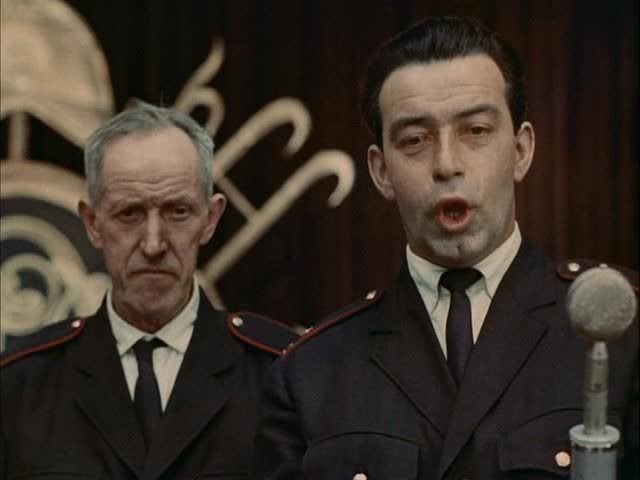
In contrast to the chaos of the party itself, the periodic shots of the announcers on stage are very static and stylized. Throughout the film, Forman maintains a rigid distinction between the way he films the brigade leadership (who represent the Politburo) and the people at the party (the proletariat). As in this shot, the committee members are inevitably presented with a somewhat distanced, formal quality that makes them seem especially absurd in the context of all the disorder surrounding them. Throughout this scene, in particular, the periodic shots of the announcers are islands of stability in a shifting sea. But this stasis does not have a positive connotation in any way. They are static, not because they are stable, but because they are helpless, paralyzed by the complete loss of control over what's happening. Forman is much more sympathetic to the wild partygoers who embrace anarchy as a response to their inept leaders; even if he sees this chaos as another symptom of a system out of control, Forman understands the urge to disorder when faced with such incompetently managed order.

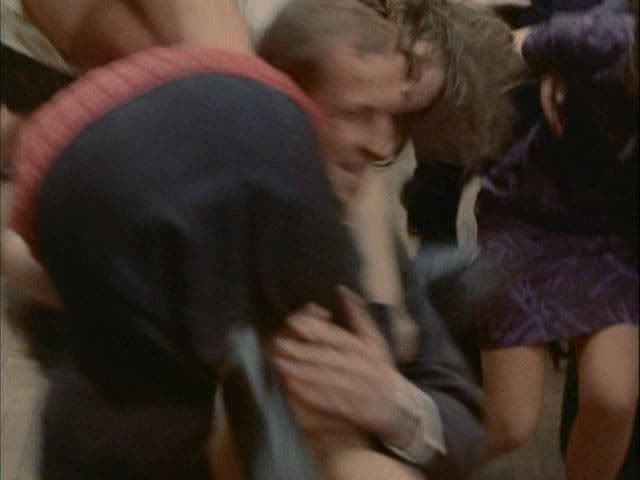
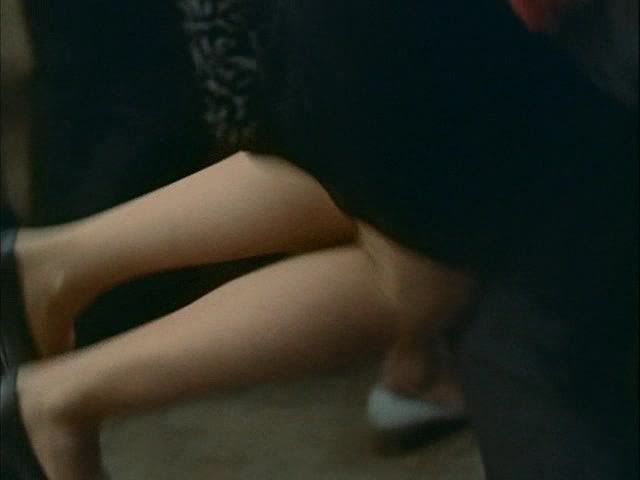
One of the characteristic features of this sequence, and the film as a whole, is the way that Forman frequently breaks down the body in shots that emphasize human movement and the awkward, messy exigencies of body-on-body contact in tight spaces. In this case, of course, the tight space is mainly the constriction of Forman's own frames, which are usually surrounding quite a few people. The next four shots are briskly edited together with lots of camera movement, as well as people moving very quickly within the shot. These shots are also mostly focused below the waist, with legs figuring in very heavily. Forman seems to have a fascination with women's legs that goes beyond mere sexualization. The focus on legs here is linked with the sequence's locomotive sensation, honing in on straining leg muscles and legs in various positions of flight and maneuvering. The scene might even be read, with some admitted stretching, in proto-feminist terms, whereby the legs that men viewed as sexual objects (the committee members got down to ground level in an earlier scene to check out the gams of prospective contestants) now become the means of flight from a demeaning beauty contest.

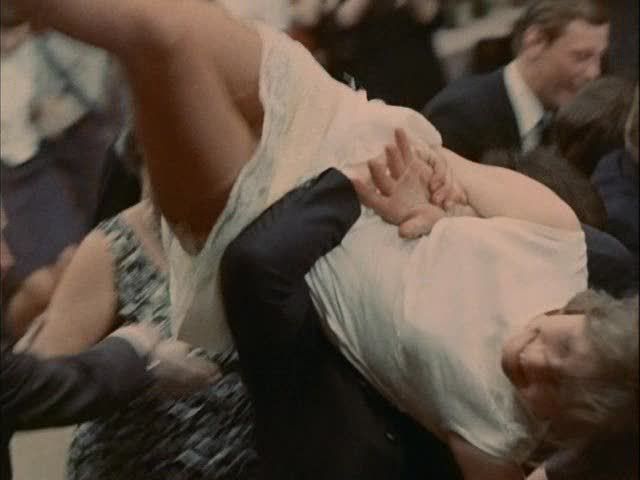


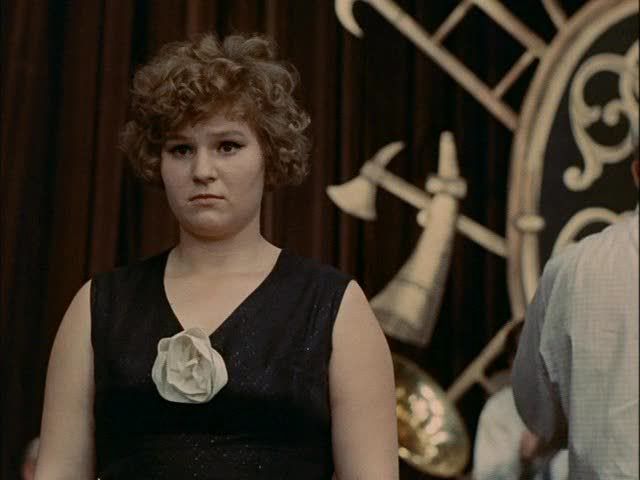
The next shot cuts back to the face of the one contestant who is actually standing on stage at this point, the first girl to go up, not because she was particularly bold or untroubled by the process, but because her father literally pushed her into it. These periodic cuts to the stage throughout this scene are moments of stasis, providing a contrast against the rowdiness of the crowd. This stasis is fleeting, though. As the scene goes by, the stage becomes less and less reliable as a source of safety from the rioting masses: the one contestant on stage makes her own flight from the pageant, the announcers finally give up and sit down, leaving the crown on the ground, and finally the rioters themselves take the stage, crowning one of their own in a triumphant end to the festivities.

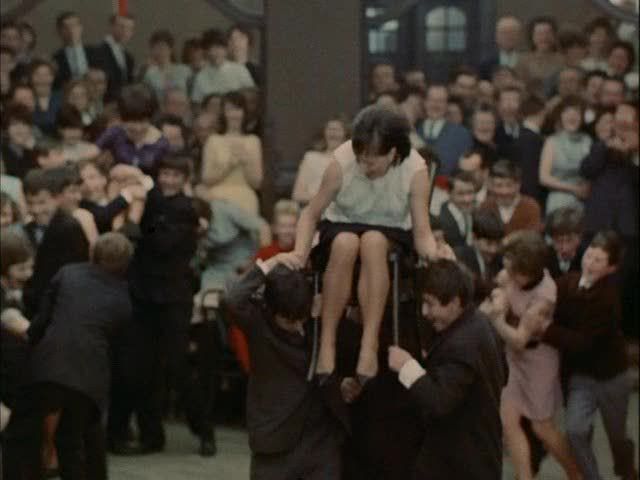
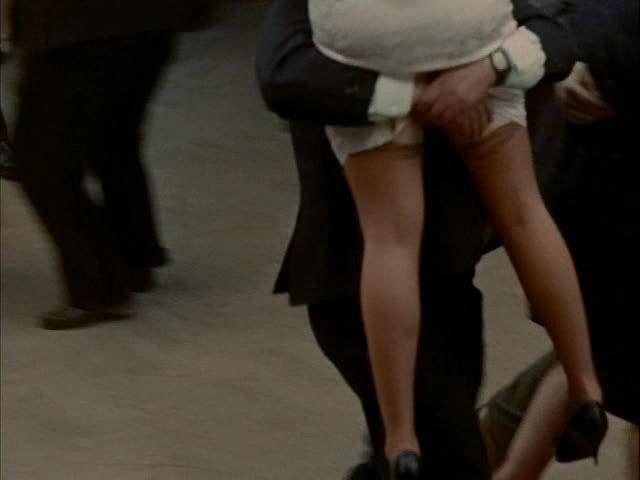
Forman next cuts back to the crowd, with a long shot of a group of guys lifting a laughing girl up onto a chair, followed by another close shot that emphasizes a woman's legs as she's carried around somewhat awkwardly.

The camera cuts back to the increasingly frustrated announcers, who by now are getting tired of holding the crown aloft awaiting its recipients, and who are on the verge of giving up for good. The slightly low angle of these shots, and the grandiose decorations on the stage behind them, sets up these figures as sources of authority, clearly placed on a higher plane than the audience. The joke is that their supposed authority turns out to be empty flourishes, as the contestants refuse to obey them in coming up on stage, and they can't even get the band behind them to keep playing without taking a break for beer — an unfortunate pause in the music that unfortunately gave the contestants just the excuse they needed to break loose in the first place. This brief shot of authority collapsing into acquiescence is followed by another of the scene's characteristic shots of men and women scuffling in the crowd. These shots are taken from ground level, keeping them at the level of the rioters' legs, thus signaling the disparity between the higher authorities and the common people below them. In this particular shot, the two people in the foreground briefly clench, then come apart as the woman pushes the man to the floor, the camera shaking slightly downward, cutting off her head and focusing more on her legs as the man's fall is completed.
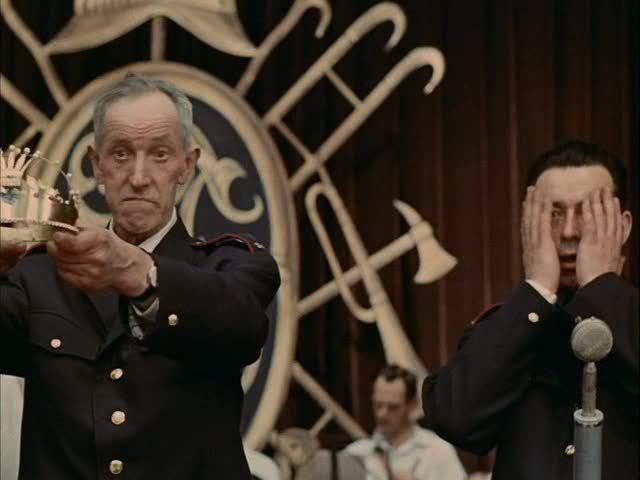
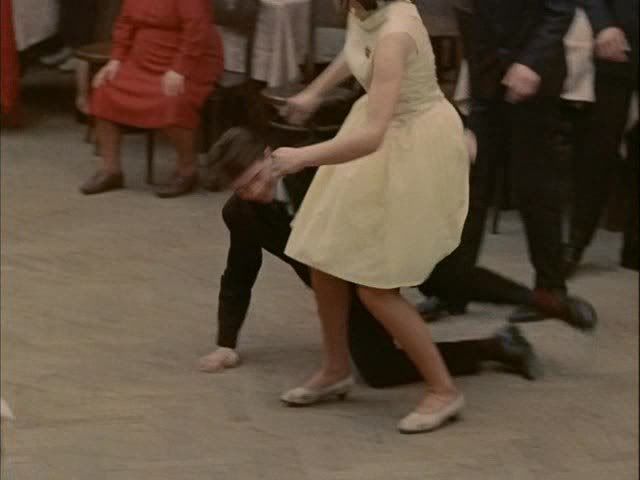

Forman's attention to legs is at times matched by the impression he gives of a sea of anonymous heads forming a monolithic crowd. Part of the film's critique of collective action is the way it captures the loss of individual identity in large masses, and the crowd scenes frequently point out and comment on this anti-individualist aspect of groups. It's easy to see this de-individualization in the many shots of legs, feet, and torsos, disconnected from their owners, but Forman's critique is every bit as implicit in the shots that show heads and faces. Even in these shots, individual people are given only fleeting representation, their faces glimpsed momentarily and then lost in the sea of undifferentiated bodies around them. Forman's frame is frequently obscured here by cloudbursts of frizzy hair and blurry, indistinct outlines of the revellers' heads. The occasional recognizable individual, like the laughing girl in the second shot below, seem to be peering out at the camera from a great distance, lost in the swirling, non-stop motion of her surrounding comrades.


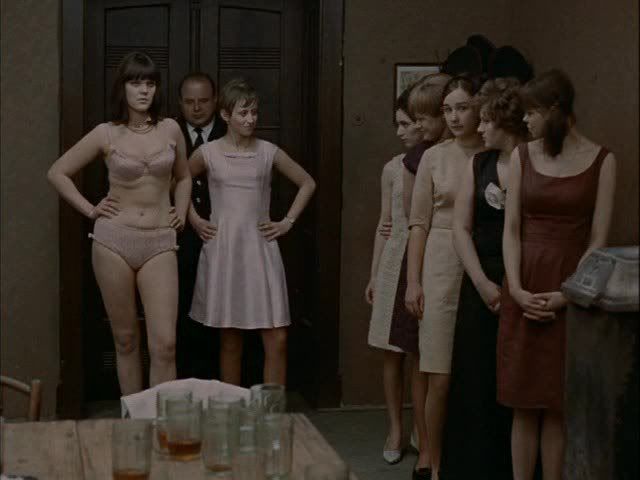
Another subtextual undercurrent in this scene is the way in which Forman treats parts of the female body usually associated with sexualized depictions, especially when they're emphasized as much as they are here. In another film, it would be hard to view an extreme closeup of a woman's butt as anything other than the most blatant of sexual exploitation on the part of the director. Forman's perspective seems to be quite distinct from this crudely sexual viewpoint. Throughout the film he points out the sexualization of women's bodies in wry, ironical ways, not at all sympathizing with the leering gazes of the firemen but instead pointing out their objectification. During the scenes where the committee members are picking their contestants, Forman continually mocks the ways in which these ridiculous men size up the women like cattle. There's a hilarious scene where the men can't decide which part of the women's bodies to look at, so they first circle the ballroom ostentatiously staring at the girls' faces, then they go up on a balcony to check out bust sizes and cleavage, and finally they're crawling around on all fours at leg level. This tendency to ridicule the men for their libidinous gaze is carried over into the scene where they make the women line up in formation, barking orders at them, and finally make them march in circles. During this drill-like pageant preparation, Forman's camera drifts down to chest level, focusing on the breasts of the women as they circle in front of the camera's stationary position. This camera placement isn't meant to give the audience any gratification, but to draw attention to the perspective of the men who are watching this spectacle; Forman simply shows us what they're seeing.

The similar shots in the context of the riot scene are not as obviously satirical — there is no observing male viewpoint for Forman to mock in this case — but they nevertheless serve a similar purpose by drawing attention to the way that the men attempt to violently, forcefully round up the women for the pageant, as though they're herding animals rather than recruiting contestants. The focus on the women's physicality, as they gleefully avoid capture, thus emphasizes the parts of their bodies that invite male attention, while simultaneously subverting this attention with the overall thrust of the scene.


Continue reading this article with Part 2.

Monday, July 14, 2008

The Firemen's Ball: Two Visions of Collective Action

[This is cross-posted at my blog Only The Cinema. This is my general review of the film, an overview of its themes and visual strategies. I plan to write more in-depth about a few specific scenes later in the month.]


Made just before he left Czechoslovakia for the US, The Firemen's Ball was director Miloš Forman's first color film, his final film in his native country, and also the reason he had to leave his country in order to continue making films. It's easy to see why. The film is, quite obviously to both modern audiences and, apparently, Czech censors, a thinly veiled critique of the Czech Communist Party and, more audaciously, of the very idea of collective action that underpins socialism. This is a deadpan, hilarious satire, documenting a single night at a small-town party organized by the local fire brigade, honoring their retiring chairman on his eighty-sixth birthday (they missed honoring him on the more meaningful eighty-fifth, a year earlier, in the first of many fumbles committed by this incompetent assemblage). From the very beginning, even before the credits, Forman sets the scene for the idiocy to come, as the firemen accuse each other of stealing the prizes from the night's lottery fund, and set fire to the banner that was to hang above the hall during the ball. The fact that they're unable to even operate the equipment to put out this small-scale blaze is both the first comment on the extent of their incompetence and a bit of foreshadowing for the film's surprisingly poignant climax.

Of course, things only get worse from here. These are men who can manage to screw up the process of selecting beauty contest participants in what seems to be a ballroom positively crammed with attractive young women. Their chosen finalists are either aggressively plain or exaggeratedly awkward, like the girl who pads her bra to such an extent that her dress seems to be held away from her body on tent posts. Forman simply lets absurd scenarios like this play out in natural ways, sticking with this anonymous and ridiculous committee as they bungle their way through every aspect of the party's planning. Over the course of the evening, the table piled high with lottery gifts is slowly emptied by multiple (and unseen) thieveries, young couples copulate under tables, the chairman seems senile and lost, and keeps executing a slow, stately walk towards the stage at completely inappropriate moments, and the beauty contest itself falls apart, in one of the film's most hysterical scenes, when the contestants all get cold feet and begin fleeing.

Forman stages all this in an atmosphere of rapidly escalating chaos, as the party spirals completely out of control. His camera is intimate, casual, and perfectly attuned to the spirit of anarchic insanity running throughout this room. Indeed, Forman often seems to be taking gleeful pleasure in the lunacy going on everywhere. His mise en scène encompasses, essentially, two different visions of collectivity: the ordered committee action of the party organizers, and the wild, unfettered anarchy of the party itself. For Forman, both of these possible outcomes are equally absurd, and both are clearly tied to aspects of Communist society — just as the fire brigade stand in for the Communist Politburo, the partygoers are the proletariat, trapped within an absurd situation with absurd leaders, and forced by these circumstances to act in dishonest and despicable ways. This is a system that privileges dishonesty. Confronted with the fact that all the lottery prizes have been stolen, the fire committee decides that the people who didn't steal will just have to think of it as if there was a lottery and they didn't win. After all, everyone bought tickets; those who stole the prizes were simply the winners. When one of the committee members has an unusual attack of guilt and is caught attempting to return a stolen prize, his comrades are angry at him, not for stealing (that's expected), but for trying to return the prize, thus damaging the reputation of the fire brigade.


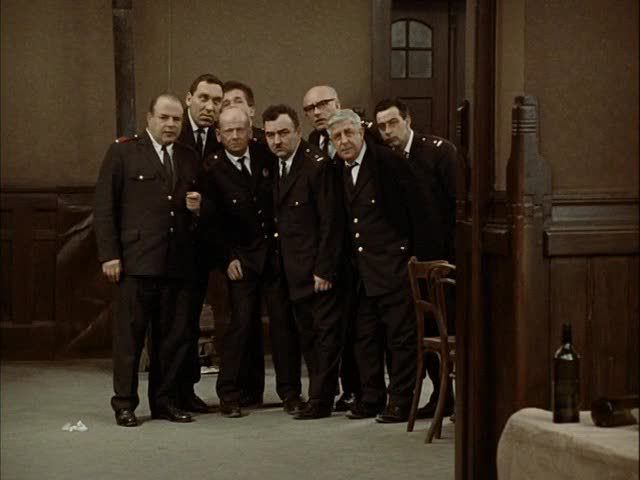
Forman's framing of the fire brigade inevitably enforces the point that they are nominally in charge but crippled by their indecisiveness, incompetence, and corruption. The group is almost always photographed together, seldom with the members isolated from one another for any length of time — the exception is when the one member has his moment of repentance. Most of them are not even given names. They are anonymous figureheads, an idealized group that acts together with no trace of individuality. Or so goes the Communist theory, Forman seems to be saying wryly. In practice, his head-on depictions of these men, massed into groups, projects an image exactly the opposite of the unity and collective action that is the ideal of socialist politics. As they cluster into tight formations, staring tentatively and fearfully at the camera, they look lost, like scared individuals trying to hide within the safety of a larger group. Forman's perspective, his deadpan camera angles and his objective distance from the assembled old men, gives them a pathetic quality that's heightened, not lessened, by their collectivity. It's this subversive questioning of collective action that is most radical in Forman's film, and is probably what the Czech censors responded to the most ferociously, even if it only registered with them subconsciously.

Not that "the people" make out any better here. The leadership may be idiotic, but the people they're leading are stubborn, unwilling to be led, and forthrightly dishonest. If Forman's vision of committee leadership is marked by its static angles and clustered compositions, his party scenes have a wildness and spontaneity that presents the reverse of this rigidly absurd group leadership. These scenes are chaotic accumulations of bodies whirling and flying past, often broken down so that only body parts can be seen. Individual shots focus on the legs of the dancers, or their arms and torsos in the midst of a frenetic riot, or their amassed heads in a sea as they listen to a speaker on stage. Best of all is the complete breakdown of order that accompanies the beauty contest, as the contestants run away and the crowd quickly degenerates into chaos, with crowds of guys attempting to corner the women and drag them on stage, throwing girls over their shoulders, even roping in girls who hadn't been in the contest to begin with. It's a masterpiece of completely unrestrained society, "the people" breaking loose of their inept masters and having fun watching the destruction of their social order. But Forman's editing in this scene is also surprisingly crisp, his images maintaining the perfect economy of his more structured compositions even when the stampeding revelers seem to be disrupting any semblance of order. Forman's portrait of disorder is perfectly conceived, achieved with a natural sense for visual rhythms and purely visual humor.

The Firemen's Ball is a delightful film, but also a film with a very serious heart beating beneath its surface humor. As the film's climax reveals, the incompetence of the fire brigade, which seems so comical in the context of a disastrous party, can also have serious consequences when applied to real world matters. When these bumblers are placed in charge of not a beauty contest but of public safety, the true extent of their bumbling, and its horrifying results, becomes readily apparent. This is why the sequence of the old man's house burning, placed where it is within the film, is so heartrending. As Forman cuts precisely back and forth between shots of the consuming, brilliant fire and the emotional faces of the observing crowd, the hopeless non-efforts of the firemen to extinguish this blaze are not funny, but incredibly depressing. The same could be said of the later scene where the committee members even bungle the presentation of an award to their former chairman, who is now dying of cancer. This old man's quiet dignity and patience in the face of the evening's many disasters make a mockery of the committee's ham-fisted attempts to honor him. A decent man in a corrupt system, he is entirely out of place here, and he becomes a victim as a result. This is a hilarious film, but its humor is cut with bitter satire, with a deep disgust for the absurdities of the political system of Czechoslovakia at the time.

Sunday, July 13, 2008

I Laugh at Danger! Milos Forman and The Firemen's Ball

by Marilyn Ferdinand

I went to my dentist's yesterday. I’ve been seeing Dr. Hamilton for more than 25 years and always assumed from his accent and attire that he was German. I got a real surprise when he revealed that he was Czech and had grown up in Prague, a couple of blocks from the old city square, just around the corner from where Franz Kafka grew up. Naturally, I couldn’t believe the serendipity of learning my long-time dentist was Czech on the same day I planned to write my FOTM Club post on The Firemen’s Ball. We talked about Miloš Forman, and Dr. Hamilton related some fascinating film and moviegoing experiences he had had in Czechoslovakia. He said he had a great story for me:

There used to be a tank on a pedestal in Prague that was supposed to have been the first Soviet tank to move into the city to liberate it from the Nazis. “Naturally,” Dr. Hamilton said, “It was a propaganda lie. The Czechs rose up against the occupying Germans as Berlin was falling and drove them out themselves.” When he went back to Prague after a 25-year absence, he asked his cab driver if the tank was still there. “Oh no, that’s long gone,” the cabbie said. When the Communists were falling, the Czech citizens stole into the night and painted the tank pink. The Russians were so embarrassed, they took it down—pedestal and all!

I couldn’t have had a better picture of the Czech spirit, as explicitly captured in The Firemen’s Ball, if I painted it myself.

The Firemen’s Ball was the last film—and the only color film—Forman made in Czechoslovakia. The warm reception of his second full-length feature, The Loves of a Blonde, helped convince producer Carlo Ponti to provide the financing that made color shooting possible. Forman and his creative partners, Ivan Passer and Jaroslav Papousek, holed up in a small Czech town to concentrate on writing the screenplay. After days of producing one bad scenario after another, the men decided to relax their minds at a firemen’s ball being held in the town that weekend. Afterwards, the ball was all they could talk about. Thus, The Firemen’s Ball was inevitable, and they were able to enlist many of the actual firemen and people in the town to appear in the movie.

When Ponti saw the film, he hated it so much that he exercised his right under his contract with the Czechoslovakian government to have his $65,000 returned. Forman faced 10 years in prison if he could not pay the government back; fortunately, he was able to show the film to Claude Berri and Francois Truffaut, and they paid his debt. Nonetheless, the government banned the film; it was unbanned for a few months in 1968 when Alexander Dubček came to power and then rebanned forever from its native screens—how absurdly Czech!

What was it about this film that Ponti and even the more relaxed Communist government of the 1960s so despised? It made fun of the proletariat! While there’s no question that the Czech people come in for some ribbing—donating raffle tickets for odd prizes that are slowly disappearing from a “guarded” table to a man who has just lost his home in a fire—the disorganized system of committee rule and the obedient functionaries of Communism are the main targets.

It’s not hard to see how the board of the firemen’s association is a stand-in for the Politburo that can’t bring order to chaos or basic goods and services to the people. Along with the party goers, we watch “Granddad’s” home blacken and burn because the fire truck is stuck in the snow; meanwhile, the capitalist ballroom owner walks through the crowd collecting on bar tabs and sets up a table from which to continue to sell drinks.

I am perhaps most intrigued by the 86-year-old former chairman of the firemen’s association who is to receive an award—a miniature, engraved axe—for his dedicated service over the years. It is to be presented by the winner of an impromptu beauty contest that, due to its runaway contestants, never takes place. The old man starts a straight, dignified walk toward the stage as the first contestant is called. He must be called back. He sits. He waits patiently as one disaster after another befalls the committee and the ball. At the very end, he alone remains in the trash-strewn ballroom. The committee hastily retrieves the box containing the award and decides to present it themselves. The old man moves forward, takes the box, and recites his carefully prepared and somewhat lengthy speech. When he opens the box, he finds the axe has been pilfered, too.

This old man is something of an enigma to me. He’s certainly the loyal Communist who comes up empty-handed in the end because of the of the system’s misshapen supply-demand curve. He’s also a leader blind to everything but his own role, the perfect bureaucrat in a broken chain, as well as a man (system) who is dying of cancer who has not been told he is ill. Finally, of course, he is an ordinary citizen who is degraded by the petty thievery of an item that can mean nothing to anyone else. This theft is both humorous—a raspberry in the face of the leadership—and a sad way for a fellow human being to be treated. Despite its high comedy, it’s no wonder the film has been called highly pessimistic.

The contemporary film movements from former Soviet Bloc countries—particularly Romania and Bosnia—identify with their traumas and open their veins. The Firemen’s Ball, though pessimistic, reflects the Czech sensibility characterized by an appreciation for the absurd, a howl of laughter in the face of danger. Forman, the only member of the Czech New Wave to have a highly successful career outside of his home country, has focused on some of his early concerns in other films (One Flew Over the Cuckoo’s Nest, Ragtime, The People vs. Larry Flynt) but without the giggles. I hope Forman finds a tank in the near future that needs a new coat of paint.

Wednesday, July 9, 2008

July's Film of the Month

Hello, FOTM club members and interested readers. Marilyn from Ferdy on Films, etc. here. The club has been a bit sparse for participation this summer—yes, we’d all rather be enjoying the summer (at outdoor film venues, perhaps?)—but the club meetings march on. Chris has asked me to pick the film for this later-than-usual start for the film of the month. I’ve chosen a film I haven’t seen but that will help with the survey I’m currently doing of the works of Milos Forman, namely, The Firemen’s Ball. My interest stems from a retro Facets Multimedia had of Forman’s Czech films and my own continuing interest in films from the Balkan/Soviet Bloc region. I’m not well versed in films of the Czech New Wave, so I hope to broaden my knowledge of this movement. I hope club members with knowledge in this area will step up with what they know. For a good overview of the Czech New Wave, read Andrew James Horton’s primer at GreenCine.

Because we’re getting a late start, I’m going to post on the film by July 13. As always, feel free to post before I do.

The Firemen’s Ball is available for rent or purchase (Criterion Collection) on Region-1 DVD through all the usual sources.

Sunday, June 29, 2008

Is This Utake Abe?

One of the more intriguing minor characters in the Golden Chance is pictured to the right. He's a servant to Wallace Reid's fabulously wealthy Roger Manning. He may be Manning's valet. (Though Lucien Littlefield also makes an uncredited appearance early in the film performing a valet's duties.) He arrives late in the film, seeming to perform more of a porter's function. In the final sequence he functions as the "hero's sidekick" when he's charged with fetching the police to rescue Manning from a sticky situation in a rough part of town.

The same actor appears in the Cheat. He has a small role in both of these two films that DeMille shot at the same time toward the end of 1915. In this one, he plays a servant to a fabulously wealthy ivory merchant named Tori played by Sessue Hayakawa- the future Oscar-nominee's star-making role. Gene Ringgold and DeWitt Bodeen's 1969 book the Films of Cecil B. Demille identifies the actor as Utake Abe. Abe's imdb profile lists many variant spellings and alternate names for the Kyoto-born actor who acted in a number of Hollywood pictures in the teens and early twenties, before returning to Japan to become a notable film director. Joseph L. Anderon and Donald Ritchie's 1982 expanded edition of the Japanese Film: Art and Industry describe the beginnings of (as they spell it) Yutake Abe's directorial career:
Comedy, long neglected in pre-1920 Japanese films, was now coming into its own, the form receiving yet further impetus when both Yutake Abe and Frank Tokunaga returned to Japan. The former had been working in Hollywood - as a butler duting long periods of "at liberty" as an actor - and came home just in time to see what [director Yasujiro] Shimazu was doing in the way of comedy. Abe's long American training had given him a profound dislike for the Shimpa style, and shortly after his return he began creating films which brought to the new comedy speed, sharpness in editing, and sophistication.
Abe would make the first film to top the annual critics' poll held by the film magazine Kinema Junpo, with his 1926 comedy the Woman Who Touched Legs, which was remade by Kon Ichikawa in 1952 and by Yasuzo Masamura in 1960. Another film Abe directed that year, Mermaid of the Land, came third in the same poll, just edging out Teinosuke Kinugasa's a Page of Madness (Minoru Murata's the Sun, not to be confused with the Kinugasa film bearing that name, came second). Abe would continue a long career as a director, making what Anderson/Ritchie call "ultra-nationalistic" war films in the early 1940s, but continuing to work through the U.S. post-war occupation period and into the 1960s.

Interesting stuff, but perhaps a major sidetrack, as no other source I've seen confirms that Abe is the same actor who appears in both the Cheat and the Golden Chance. Many sources, including Robert S. Birchard's Cecil B. DeMille's Hollywood, identify him as playing Tori's valet in the Cheat. However, there are two distinct actors whose characters performed as servants to the ivory king. Either might be considered a valet, and the one pictured to the left is the one with a title card of dialogue in the film (the closest thing silent films had to "speaking parts" I suppose). The question becomes, how reliable is Ringgold and Bodeen's information? As a researcher I've grown to become wary of the accuracy of data found only in a single secondary source and not corroborated. I'd love to be pointed to another source with a picture of Abe, whether in the Hollywood or Japanese phase of his career. I'm on the list to receive Daisuke Miyao's book Sessue Hayakawa: Silent Cinema and Transnational Stardom when a copy arrives at my local library, in the hopes that Abe is discussed or pictured. Anyone else have any guesses on leads?

Whether it's Abe or another man, I remain curious about the actor who played an on-screen servant to both the heroic Wallace Reid and the villainous Sessue Hayakawa at precisely the same moment in film history. What stories could he tell of the film industry attitude toward Asian-born actors in Hollywood at the time? What would he say about Hayakawa? About DeMille? I'd love to know.

Sunday, June 22, 2008

Upstairs/Downstairs and Conventional Morality

CB DeMille was nothing if not a conventional moralist. The Golden Chance, which has rightly been commented upon as a Cinderella story, is also Dickensian, with obvious parallels between the character of Mary Martin and Nancy, the abused and eventually murdered wife of thief Bill Sykes in Oliver Twist. Unlike Dickens, however, DeMille has no real interest in social reform. His Mary is not to be pitied for her situation in the same way we feel for Nancy. Mary chose to degrade herself with an unsuitable marriage below her station. DeMille, therefore, affords (likely unintentionally) a particularly twisted entertainment to the working-class women of the time—fantasies about being Cinderella at the ball and smug satisfaction at watching one of their betters pulled down off her pedestal and treated just as they would be treated by the ruling class.

Were DeMille willing to toss out his moral compass, he would have left no doubt about Mary’s instant availability to Roger upon the death of her husband. But for DeMille, the sanctity of marriage and knowing one’s place are far more important than individual happiness. There are many enforcers of the status quo: Mrs. Hillary’s maid, who gives Mary a dressing down for dressing up; Steve Denby, who sneers that Mary is no better than him just because she is a judge’s daughter; Mrs. Hillary, who uses Mary for financial gain and then makes sure Mary can’t do the same with Mrs. Hillary’s loaned jewelry. Despite the possibility of physical harm, Mary never seriously entertains leaving her husband and seems distraught when he is killed. There is no look of relief on her face that he is finally out of her life for good, and no final clinch with Roger. She probably realizes that Roger will never believe that Mrs. Hillary put her up to the deception, that is, if Mary would be so disloyal to her class again as to betray the Hillarys. And that will never happen. Mary will have a rough time as a single woman—and she deserves it, DeMille seems to imply.

In 1919, DeMille will have more fun with social convention in Don’t Change Your Husband (working again with the writer of The Golden Chance, Jeanie Macpherson). Still affirming the sanctity of marriage, DeMille allows his upper-class heroine, played by Gloria Swanson, to divorce her wealthy, but inattentive and slovenly husband to marry a man of her own social standing who turns out to be far more flawed than her husband. She, too, playacts at a costume ball at which her would-be lover is dressed as a king and she as a queen. Already in enviable circumstances, the characters must impersonate royalty to find suitable models for their aspirations and feelings. Her first husband reforms to win her back—affirming that he now takes marriage seriously and as something not to be taken for granted. No harm, no foul in this case. The larger transgression, it would appear, is betraying your own kind.

The superior-quality melodramas that comprise the genre of Women's films have remained surprisingly true to form over the years. Take a look at the films of Douglas Sirk and his spiritual protege Todd Haynes and see their inspiration in these early Women's films from the dawn of movie-making.

Thursday, June 19, 2008

Popular (Silent) Film History

Brian has started off the discussion with a detailed and useful consideration of the continuity editing in The Golden Chance. I want to step back to reflect on how we (as cinephiles) approach a film like DeMille's. Popularly, silent film, most of all early silent film, does not fare well; just witness the Netflix stars or imdb ratings. Meanwhile, a popular cinephilia often falls prey to the "Griffith narrative": American cinema fumbled through awkward, one-reeler melodramas til D.W. Griffith refined a more supple film language and invented classicism. I myself have subscribed to this understanding, until I have watched a little more 1910s cinema. Crucially, I have to credit Kristin Thompson and David Bordwell's Film History textbook for breaking me of this lingering historical picture. For they point out Birth of a Nation's importance in elevating the social status but seem to isolate the formal innovations elsewhere, either in Griffith's early work or in other films of the mid-to-late 1910s. And once one starts to look closely, one can begin to draw a different picture.

The Golden Chance
, for example, lacks the epic scope of Birth of a Nation, the tracking shots, or the touches like the activation of off-screen space. But it feels to me closer to the direction in which Hollywood films would follow in the 1920s: continuity editing to give studio sets an illusion of 3-dimensionality (what Noel Burch calls haptic space), true yoking of dual-subplots, and most of all expressive use of artificial lighting. Meanwhile, 20s Hollywood arguably would forsake some of the Griffith traits, such as the schematic, naked parallel editing, a practice to find a more subdued existence. Thompson and Bordwell use The Cheat as an example of this pioneering use of lighting, but The Golden Chance revels in the new effects as well, even from the credit sequence, in which lighting reveals then conceals the drunken husband against the backlit window backdrop.

Also, arguably, while racism and white privilege remained a strong, dominant current, I'd venture that The Golden Chance is closer to Hollywood's key ideology than Birth of a Nation. Crucially, the Cindarella narrative taps into an ur-narrative of class transcendence (conflict meanwhile is external in BoaN). I've always been struck at how often in Hollywood films, to borrow and revise a phrase from Laura Mulvey, the glamorous impersonates the ordinary impersonating the glamorous. What's still missing in The Golden Chance is the complementary class transcendance: in mature classicism, the rich (here the millionaire Roger Manning) would themselves be breaking free of the stifling social roles and class traditions to truly experience life. Undoubtedly, films drew upon popular theatrical, melodramatic, and literary precedents in these narratives and ideologies. I would love to explore this period more, to watch more, and to read exactly what led to Hollywood's ideological formula, which seems established by the 1920s.

Moreover, not being a specialist in the period (and early classical film is really only beginning to get a fraction of the scholarly attention that early and transitional cinema has generated), I find myself asking: is The Golden Chance typical of what an American studio picture of the mid-1910s looked like? Or is De Mille exceptional? Maybe some film-of-the-month clubbers can help answer these questions.

Thursday, June 12, 2008

The Golden Chance: a Photoplay

Cecil B. DeMille began directing films in late 1913, after forming an alliance with Jesse L. Lasky, Lasky's brother-in-law Samuel Goldfish (who would later change his name to Goldwyn) and attorney Arthur Friend. None of them had been involved in making motion pictures before, and the name of the new venture, the Jesse L. Lasky Feature Play Company, indicated the company's theatrical beginnings. Lasky had been a vaudevillian, and DeMille had come from a family of playwrights. The pair had initially joined forces as producer and director of not-terribly-successful Broadway productions.

The Jesse L. Lasky Feature Play Company's first film, released in February 1914, was the Squaw Man, based on a very popular play by Edwin Milton Royle. Indeed, the majority of films DeMille would direct over the next two years would be adapted from the theatre: the Girl of the Golden West and Rose of the Rancho by David Belasco, the Warrens of Virginia and the Wild Goose Chase by Cecil's brother William, and quite a few more, including a version of Carmen that for legal reasons had to be positioned as an adaptation of Prosper Mérimée's novel, but that starred opera diva Geraldine Ferrar and was certainly intended to exploit audience interest in Bizet's opera. Like another failed playwright named D.W. Griffith, DeMille had a theatrical instinct that helped broaden the cinema's reach beyond the Nickelodeons, attracting middle-class audiences clamoring for narratives that would be sustained for more than just a reel or two at a time. Unlike Griffith, he never released a film less than four reels long (about an hour in duration).

But beginning in 1915 with the Captive, DeMille began directing films based on original scenarios. Two of these were produced, for all practical purposes, simultaneously, one during daylight hours and one at night: the Cheat, with a script by former theatre critic Hector Turnbull, and the Golden Chance, by DeMille and his writing partner (and mistress) Jeanie MacPherson. Sumiko Higashi, in her 1994 study Cecil B. DeMille and American Culture writes:
A move that secured his claim to authorship, the decision to collaborate with a scriptwriter rather than to purchase rights to existing works was also cost-effective: Macpherson received $250 for the script of The Golden Chance, whereas playwright and novelist Charles Kenyon was paid an advance of $2,000 against 10 percent of the royalties for the adaptation of Kindling.
Higashi describes the Golden Chance as "an exercise in middle-class voyeurism with the heroine in the mediatory role of a tourist." As in the Squaw Man, Carmen and other DeMille adaptations, much of the drama of the Golden Chance lies in the crossing of social class boundaries, in this case on the part of the audience surrogate Mary Denby, played by Cleo Ridgely. We are not shown Mary's transformation from judge's daughter to struggling wife of an impoverished alcoholic; it's revealed in a newspaper headline seen at the beginning of the film. But her role-play as a high-society belle in a scheme concocted by Mr. and Mrs. Hillary (played by Ernest Joy and Edythe Chapman) invites the viewer to dream of an opulent life with rich, handsome Roger Manning (played by Wallace Reid) just as the scenes involving Mary's husband (Horace B. Carpenter) serve as a warning against marrying below one's station.

If none of this narrative material seems likely to appear fresh to modern observers, it probably wasn't particularly fresh at the time, either, at least not to anyone familiar with the Cinderella myth. What comes across, then and now, is how the story is told. The cinematography, especially the lighting, has been praised approximately as often as the film has been written about. In his recent DeMille biography, Simon Louvish extracts the following passage from a Peter Milne review for Motion Picture News contemporaneous to the film's release:
...the countenances of the players are clearly defined by rays of light that strike them full in the face, leaving the backgrounds totally dark...aiding the story beyond measure...
Higashi quotes W. Stephen Bush from Moving Picture World:
If the paintings in a Rembrandt gallery or a set of Titians or Tintorettos were to come to life...and transferred to the moving picture screen the effect could not have been more startling.
Perhaps just as interesting as the lighting is the staging and editing of the film, especially as it develops across the sweep of the picture. In the first reel or so of the Golden Chance, each of DeMille's cuts comes at a natural geographic separation point, almost as if a scene shift in a play. Every shot concludes either a) at the moment of an explanatory or dialogue title card, b) at a shift of location from one room or one location to another, or c) at a shift of focus to a character entrance, as when DeMille cuts from Mary hearing someone at her apartment door and responding (mouthing) "come in!", to the rent collector entering through a door in the room unseen in the previous shot.

It's only in the DVD's 18th minute, during Mary's debut at the Hillarys' party for Roger Manning, that DeMille begins to stretch his continuity editing muscles. Though the occasion is once again a character entrance, the cutting is much more complicated than anything seen in the film up to this point, and it remains at this pitch for the rest of the sequence. After a title card announcing Mary's arrival in the room ("The Substitute.") we see Roger Manning entertaining a trio of young women at the gathering.


Cut to Mary, beginning her descent down the grand staircase.


Back to Roger and his group, now noticing the new arrival in the room.


Then a shot establishing the geography of the room and the distance between the two.


A close-up of Roger, looking intently at his object of attraction.


Mary, surveying the scene.


Back to the establishing shot, as Mary continues her descent into an attractive but ultimately forbidden world.


As she completes her journey down the steps, she is greeted by her duplicitous guide, Mrs. Hillary.


One final shot before we get to the title card bearing Mrs. Hillary's introduction.


Mary and Roger have been introduced, and now we get the payoff: a two-shot.


The scene continues with a lavish dinner filled with continuity editing choices, cross-cut with a single-shot scene of Mary's husband scrounging for sustenance at home. It's as if DeMille is using cuts within a scene to signal Mary's fantasy world; either its dream-come-true quality, its mendacity, or both. Unvarnished truth about the dark side of urban society gets relatively long takes that may or may not hearken back to theatrical staging strategies, but the world of hopes, desires, and lies is gloriously woven together by splicing tape in the Grand Hollywood manner, as only the cinema can achieve.

Approximately a year after the Golden Chance was released, DeMille's first full-blown epic was unveiled: Joan the Woman. It was not as financially successful as had been hoped, but that did not deter the director from continuing to attempt to bring more and more opulence and spectacle to his films. By the time he remade the Golden Chance as Forbidden Fruit (a film I have not seen apart from a few clips) in 1920, he felt it necessary to include "elaborate Cinderella fantasy sequences," as Robert S. Birchard has described them, that caused its budget to soar to well over $300,000, where the original version had cost under $20,000 to produce. However, few who have seen both films report Forbidden Fruit to be more effective than the Golden Chance.

-Brian Darr

Sunday, June 1, 2008

June's Film Of the Month

Greetings, Film of the Month Clubbers! My name's Brian Darr, and I'm a cinephile and blogger born and bred in the fertile movie-watching ground of San Francisco, California. I don't know about you, but my mind's still reeling a bit from the fascinating discussions held here regarding Girish Shambu's May selection the Emperor's Naked Army Marches On.

But it's June, and you may be wondering what the new Film of the Month Club topic is going to be. Chris Cagle, the instigator of this discussion hive, asked me to make this month's selection, and I've decided to go back to a much earlier era this time out, to a film released at the tail end of 1915: Cecil B. DeMille's the Golden Chance, starring Cleo Ridgely and Wallace Reid.

Unlike Girish, I'm not brave enough to pick a film I've never seen before. Just a little background on why I chose it: while volunteering as a researcher for the San Francisco Silent Film Festival last year, I went on a mini-binge of DeMille silents. I also took a closer look at Robert S. Birchard's book entitled Cecil B. DeMille's Hollywood. Starting from the preface Birchard's book pointed me toward this particular film. I found it fascinating, and I hope those who join me in watching and writing this month do too.

Like Girish did, I'm going to give myself a deadline for my own contribution to this month's discussion: June 12th. If others are able to watch the film and post something before then, that's just fine by me.

The Golden Chance is available to view on a region-1 DVD available through Amazon, Netflix, GreenCine, the San Francisco Public Library and certainly elsewhere, I'm sure.

Saturday, May 31, 2008

Post-Griersonian Documentary

First off, thanks to Girish for picking Emperor's Naked Army Marches On - such a fascinating film, and one I likely would not have caught on my own - and orienting us to what's been written and said about the film. The ensuing conversation here has been rewarding to read and daunting to add to. All in all, a great start to the club. June's movie will be announced soon.

A number of you have brought up the ways Emperor's Naked Army questions hegemonic documentary practice: its continuum between documentary social actor and fictional character; its direct acknowledgment of the camera; its thematic interrogation of ethics; its own ethical problematic in facilitating violence; and its use of the performative persona of Okuzaki as a key author-agent of the film.

These are all important - central to the film, even. But I want to sidestep them a little without sidestepping the representational challenge of the film.

And the film is challenging. The spectator is placed in a position of piecing together events from their recounting. Social conflict plays out as ritualistic confrontation. The historical context is distant to viewers not versed in Japanese politics and removed generationally from World War II. Most of all, like other observational documentaries, ascertaining tone is difficult. Ignatiy remarks, "[Hara] may may be giving the real-life Okuzaki authority, but the filmed Okuzaki is a character in Hara's movie. And the movie's intentions are quite different from Okuzaki's." But what are the movie's intentions? And how do we know what they are?

To begin with, the film's narration does surface at key moments. Seymour Chatman talks of the "implied author" effect in narrative cinema, and at crucial times Emperor's Naked Army, too creates an implied author that lets the spectator weigh the veracity of what the interogated officers say. For instance, the film cuts from a verbal account of a 3 day lag before hearing of the war's end to an intertitle telling that 23 days passed instead.


But such blatant assertions of narrational voice are few. I found myself (perhaps unjustifiably) going back to the interview Girish quoted and to Jeffrey and Kenneth Ruoff's helpful reading. From these I gathered that Okuzaki's confrontation appealed to Hara as a way around the static social relations of the documentarist-social actor relationship that forms the basis of Griersonian documentary. This is more than a formal choice: Hara seems to be critiquing political consensus, most likely from a leftist perspective. Ruoff further argues that Hara seizes on the individual figure of Okuzaki as means of opening up a taboo debate about Japanese moral culpabilit

Thankfully, I dug up Akira Lippet's review of Ruoffs' monograph (Film Quarterly Summer 2000) and found my ideology of liberal consensus reading seconded. Lippit is taking issue too with Ruoff's political reading:
Okuzaki's ultra-rightist critique of the Emperor paralyzed Japan's facile politics of the right and left. To state that "after the war, Japanese people preferred to identify with the civilian victims of the A-bombs, rather than with their own soldiers who committed atrocities all across Asia," is not only illogical, but participates in a false dialectic that sees Japan's failure to acknowledge and accept responsibility for its extensive crimes in direct contrast to the American use of atomic weapons in Japan. It is a polemic that appears nowhere in Hara's film, which remains unrelentingly focused on Okuzaki's pursuit of a justice that is both extreme and private.

I, too, had problems with the Ruoff reading: Okuzaki's crusade seemed to challenge militarism in highly militaristic terms of honor and responsibility. But the broader point here is that Emperor's Naked Army seems to stage a confrontation and a revelation of truth without the redemption of dialogue, contemplation, deliberation, or action. Formally and ethically, many documentaries eschew the forms of Griersonian documentary, but this one dismantles the core principles of public sphere address. Documentaries - even personal experimental documentaries or Michael Moore's ironic agitprop - often ask their spectator to know something for future action or even ask her to act now in some capacity as citizen. Emperor's Naked Army mocks this quest for knowledge while enticing it, poses any deliberative action as quixotic while taunting those who are inactive, and sides with confrontation over reason. How many times does a cornered social actor fall back on a defence of "that's my opinion" while the framing registers his deer-in-headlights expression?

Intellectually, it's great to have this problem posed for us to reflect upon. Normatively, though, I don't think this Post-Griersonian worldview lines up simply on the side of the angels.

Thursday, May 29, 2008

Authorship in Kazuo Hara's Films

Thinking about The Emperor's Naked Army Marches On made me curious about Kazuo Hara's other films. Earlier this month I watched his two earlier films, Sayonara CP and Extreme Private Eros: Love Song 1974, hoping to get a better idea of Hara as a filmmaker. I posted some notes on his style and themes at my blog - but now I'd like to address another characteristic of these films I put off from that post. This emerges, specifically, from some of Harrytuttle's comments here, that Okuzaki seems to be more important to the film than Hara. It's an interesting point - in fact, I think it is characteristic of Hara's approach.

His films are definitely about strong personalities: the poet and photographer in Sayonara CP, Miyuki Takeda in Extreme Private Eros, and Okuzaki, are all assertive individuals with their own agendas. But usually even documentaries about strong characters retain a fairly clear hierarchy of "authorship": the subjects (Bob Dylan or Mark Borchardt or the Crumbs) do their thing - the filmmakers (Pennebaker, Smith, Zwigoff) film it and shape it. The subject of the films may control their discourse - but the filmmakers retain control of the discourse of the film. But Hara cedes more control of the films to his subjects - he allows them to shape what is in the film, to comment on the film more directly. Okuzaki's crusade is a good example - along with his tendency to perform, to stage manage confrontations, to act violently (though always photogenically). And his control of what will be in the film - inviting Hara to film him killing Koshimizu is probably the extreme example, but there are others. Several posts and comments here have explored Okuzaki's "shtick", so I will concentrate a bit more on the earlier films.

In Sayonara CP, the Greenlawn group (an organization of cerebral palsy sufferers) has significant input into the film, shaping its content, and its purposes. When the film is endangered (the wife of one of the main characters, the poet, Hiroshi Yokota, demands he stop filming), the Greenlawn people are as adamant about continuing as Hara. (And a good deal more vocal - he just keeps shooting; they yell at Yokota, nearly get into fight with him.) Beyond this, both Yokota and the other main character, a photographer, are given extended scenes, and explain their ideas and hopes at length. Hara has spoken of his desire to show things that are hidden - the CP sufferers share this desire. The photographer says he began taking pictures because other people took pictures of him - "we can only be passive" he says - he wants to reverse that, to look, as well as be looked at. He implicates Hara in this - Hara was always photographing him, he says - now he wants to be the one with the camera. Yokota, the poet, has similar goals - to read his poetry in public, to make people look at him, listen to him, acknowledge him. He has a major speech at the end of the film - describing his hopes for the film, for a different kind of film, only to have those hopes shattered. He will always be helpless, he says - while Hara cuts between shots of Yokota sitting nude in the street and repeatedly trying and failing to stand. Whose idea was that? Hara's? Yokota's? Either way, it pits the image against the words in a way that, I think, that underlines the authority of the character in the film. Both of these men resist their appropriation by the film, at least by speaking about it directly.

Hara's second film, Extreme Private Eros: Love Song 1974, contains perhaps the most extreme example of this shared authorship. The film is a portrait of Hara's ex-lover, Miyuki Takeda - an extraordinary woman in her own right. The first half of the film is fairly conventional, as far as the relationship between Hara and Takeda, as filmmaker and subject, go - he shoots her, she talks, goes about her business - but the film is basically his. But in the second half the relationship changes. He films her giving birth - but this was her idea. We heard her plans earlier - she wants to give birth completely alone, with no help from anyone: and wants Hara to film it. That is what happens. She has the baby, while Hara films and his current lover records the sound. This scene is hers by any standards - she plans it, does the work (to say the least), and Hara just records.... This also tends to recast her activity in the earlier scenes - Hara tagging along as she went through the Okinawa underworld, trying to help the women there. Only at the end do we learn what she was doing there: by the end, seeing her efforts to create a model community, we see her as a far more active character than before.

Now - I don't think this in any way diminishes Hara's contributions to the films, and I certainly don't think it makes them less interesting formally than other documentaries. On the contrary - I think it makes the tension between the subject of the documentary and the maker of the documentary more explicit. It plays into the broader issues of control and independence found in these films, and often into their themes of revelation and repression - as all these characters in many ways seek to say and show things that have been suppressed. In this they are partners with Hara - though as well, as a filmmaker, he is appropriating their words and their images for his own purposes. They often, fairly explicitly, try to take control of those words and images back. It makes for a fascinating interplay.

Tuesday, May 27, 2008

Two Still Images

A man wrestling Okuzaki to the ground smiles up at the camera.


A woman takes a picture of the crew during Okuzaki's interview with a man he'll later attempt to kill.


Kazuo Hara's Kenzo Okuzaki

A lot of our writing so far has focused on Kenzo Okuzaki. So, in the spirit of the sport, let's turn around 180 degrees. After all, there's no such thing as passive filmmaking: Kazuo Hara (any by extension producer Shohei Imamura, editor Jun Nabeshima and sound recordist Toyohiko Kuribayashi, whose silver microphones are always peeking in from the top of the frame) is the secret co-protagonist of The Emperor's Naked Army Marches On.

***

Like any good social drama, The Emperor's Naked Army Marches On opens with a wedding and ends with a crime. In between, Kenzo Okuzaki, a man in his 60s, travels across Japan, first in a van covered with hand-written signs, then by train and ferry, confronting veterans about atrocities committed by Japan against its soldiers during World War II. Thin, wiry, with a finger missing on his right hand, he has the bearing of a wild dog. He's got the kind of vitality than only comes with age; his anger is the spirit of a man fighting time. The passiveness of the people he confronts is the kind that comes from accepting infirmity. "Everyone has the right to live in peace," says an incontinent veteran. A few minutes earlier, Okuzaki had kicked him to the ground.

Director and cameraman Kazuo Hara is Okuzaki's accomplice and Okuzaki is Hara's. Okuzaki's actions are motivated by the presence of a camera crew. He coerces people into confessions not for the sake of confessing, but for the sake of capturing them on audio tape and film. He's uninterested in "stories everyone knows." He wants to make private burdens public. Things must be said not to be said, but so that others can hear them. When a man offers to tell a soldier's relatives about war atrocities in private, Okuzaki angrily refuses with the authority of a director asking an actor for another take.

But Hara has the upper hand. He may may be giving the real-life Okuzaki authority, but the filmed Okuzaki is a character in Hara's movie. And the movie's intentions are quite different from Okuzaki's. It's after a secret, morally complicated history, and finds the perfect vehicle by presenting a man who openly sees the world in black-and-white. The film's Okuzaki is the lie that tells the truth. His aggressive, mannered personality is like a pane of polished glass, completely transparent and reflective of everything around it.

Watching films, we become astronomers, who detect the locations of planets and stars through calculations and hypotheses instead of images. No one needs to tell us that the real-life Okuzaki is tolerated as a crank, because the filmed Okuzaki's confrontations are always bookended with his polite arrival and equally polite departure. His "victims" are rarely apologetic about their wartime actions but always apologetic about the house being a mess or not having anything for tea. No one needs to tell us that the past is something muddled and impossible to understand--more opaque than the future, even--because Okuzaki is so hell-bent on simplifying it, on having everyone stick to one story. A receptive interviewer would only mirror his subjects. A passive one would only reveal his motivations. But here he is, replacing a soldier's grieving relatives with actors (his wife, a friend and a like-minded anarchist) who ask less questions and project more dread. And by showing us a false simplicity, Hara shows us how complicated truth can be.

--I. Vishnevetsky

Monday, May 26, 2008

Memorial Day thoughts on Kenzo Okuzaki

In the beginning, there was the camera. I'm no historian, but I'm easily swayed by the argument that social protest as we now know it did not exist before the invention of photography. It provided a reliable recording device that could prove to observers across space and time that, indeed, the authority of the powerful was being challenged. Would peace marches exist without cameras to record them? Would flag-burnings? Would Kenzo Okuzaki?

In the Emperor's Naked Army Marches On Okuzaki tracks down the surviving members of Japanese Army squadrons that were stationed in New Guinea, confronting them to tell the stories of their involvement in unspeakable acts in the days following the news of their country's surrender to General Douglas MacArthur. John Farr calls him a "one-man truth-and-reconciliation committee", which might sound overly-glib but opens an interesting line of inquiry. South Africa's TRC was designed to bring the truth of the apartheid regime into the light. Some felt the commission placed too high a value on truth at the expense of justice. Okuzaki also is committed to pursuit of truth, facts, and information. When he uses brute force on his interviewees, it's not so much a method of justice or punishment, but coercion so that they'll do what he wants them to do: spill the beans.

But I don't think Okuzaki is uninterested in justice either; he talks of a kind of karmic retribution for post-wartime crimes in the form of physical ailments. He's unabashed in claiming his moral superiority over those he confronts. And the camera too performs a role in meting justice or punishment. It's often alluded to that family honor is the obstacle to honest confessions by the former soldiers. Okuzaki appeals to a higher set of ideals, arguing that the revelation of truth about murder and cannibalism will comfort the victims' souls, and that this is a greater goal than maintaining the integrity of family honor. But it seems likely that he also feels that getting his interviewees' testimonies on film is its own form of justice. I'd be curious to see a follow-up on how the successful release of the Emperor's Naked Army Marches On in 1987 affected the lives of the former soldiers in the film, and their families.

-Brian Darr

Wednesday, May 21, 2008

Okuzaki's Shtick

Following Rick Olson's "Prophetic Performance and the Documentary Gaze", I find that I'm fixated on Okuzaki Kenzo's shtick, on his performance of himself before Hara's camera, on what performance studies types like me might call Otuzaki's "autoperformance" (click here for an apt elaboration of the premise within a performance art context).

As we see throughout the film, Okuzaki is an adept improviser, capable of calibrating his autoperformance to provoke or to calm his audience in a flash second. Yet, like the most skilled improvisers, Okuzaki also relies upon some well-rehearsed stock pieces, familiar bits of business easily deployed at a moment's notice depending on the audience's shifting needs. Hara's camera captures most of Okuzaki's shtick repeatedly. Indeed, by the end of the film, the viewer has perhaps unknowingly become something of an expert on Okuzaki's distinctive "act."

To illustrate, Okuzaki deploys different items in his repertoire toward distinct effects. Some redirect the action of the scene when things threaten to spin out of his control ("I'll call the cops for you"). Others utilize ostensibly factual declaratives to verbally reassert Okuzaki's authority ("I went to prison for 13 years and 9 months" or "You were my commander but I'm a better man than you"). Still others are mostly non-verbal as when -- in each of his three filmed assaults on his interviewees -- he pauses, while poised in a position of dominance, to politely request his victim's assent. Hara's film fully documents these performative aspects of Okuzaki's ambush interview style. In so doing, Hara's camera forcefully illustrates that, as much as each encounter is its own "real" event occurring in its own "real" time, Okuzaki has the benefit of ample rehearsal for his part in each performance.

Perhaps the most vivid demonstration of Okuzaki's shtick comes in his brief collaboration with the surviving siblings of the two murdered privates. As these grieving individuals get into the swing of Okuzaki's act, they too begin to improvise, demanding their own answers from the interviews as distinct from Okuzaki's own interrogatives. The siblings' privileged status as visibly grieving survivors inspires the sustained attention and respect of the interviewees (which Okuzaki is quick to exploit as he forwards his own, by now familiar, claims). But these grieving siblings also upstage Okuzaki, as the interviewees increasingly direct their communication to the family members and ignore Okuzaki. Little surprise then, when the siblings -- for reasons that not made clear by either Hara or Okuzaki -- choose not accompany Okuzaki on future outings, that Okuzaki folds "their" presence into his own shtick by "casting" his wife and friends in the roles "originated" by the actual siblings, directing them to "act well but let me do the talking."

Okuzaki understands the circuit of performance -- recall his instruction to the grieving mother to "start over" when she "messed up" her vocal lament for her lost son -- but the fact that he's performing doesn't make his actions any less "real." Consider his savvy expression of his alibis, his "reasons" for doing what he's doing. I caught three, usually presented in the same sequence and using the same inflection. The first ("to console the souls" of the dead) assuages the spirit, while the second ("to tell the truth about war" so as to prevent future conflicts) addresses the conscience. Okuzaki seems to intuit that these first two make sense to most people. This might be why Okuzaki keeps the lid on his third and arguably most imperative reason ("to reveal Hirohito as a war criminal") the only one of his alibis to directly address the intellect -- for it outs Okuzaki as something of a crackpot and is especially vulnerable to what becomes a familiar rebuke, "That's your opinion." (Indeed, the statement "that's your opinion" seems to work like kryptonite for Okuzaki, requiring that he immediately reboot his performance with a distinctly different bit of business.)

Yet as much as Okuzaki is a skilled performer, I suspect he's most interesting for his adept use of the performative. Okuzaki's "act" -- through careful verbal and embodied repetion -- does help to instantiate the evidentiary reality of the counternarrative he seeks. The "truth" is revealed through Okuzaki's shticky fakery. All of which opens yet another angle on the question that everyone seems to have about this film: would Okuzaki's autonomous, adept performance shtick have done the work we see it do without the ratifying audience provided by Hara's lens?

-- Brian Herrera AKA StinkyLulu
(see also my unedited ramblings on the film here)

Monday, May 19, 2008

Hara's Naked Victims Mourn On.

The Emperor’s Naked Army Marches On (Kazuo Hara, 1987)


What was Kenzo Okuzaki? Was he a dismissible war veteran with little more than a senile axe to grind? Or an ageing yet dangerous element posing a real threat to civilized society? I believe he was both of these things and more. Okuzaki is a ghost, a murderous revenant of the regime that created him. As Jacques Derrida disclosed in Specters of Marx, ‘haunting belongs to the structure of every hegemony’(1). For Okuzaki, the purported institutional betrayal by the Japanese Imperial army in an illegal execution of mutineers, after the Pacific War had already ended. Defined him as representative, avenger, spectre of the wronged dead in opposition to the passive hegemony of a society in silence, guilt and ignorance.

Kazuo Hara’s direct documentary film is a fascinating jaunt into contentious national historiography, documentary subjectivity/objectivity, the return of the repressed and the fragile limits of righteousness. What makes Okuzaki, as well as Hara’s film, so compelling is the ambivalence that persists in every one of these issues. Although Okuzaki is a ghost, and certainly Hara has ensured of his immortalization. Should he be regarded as a righteous ghost? Hara’s own anti-social credentials: ‘I make bitter films, I hate mainstream society’(2), seem to erode any claims to the sanctity of objectivity in this film and consequently Okuzaki’s quest. Yet this outlook of bitterness could only detract from the potency of, exposing injustices as they are. On many occasions, the camera was self-reflexively pointed to as a weapon and presence of cinematic duress to which the subject should submit.


Okuzaki’s own claim to be representing “divine truth” is set about by dirtying his hands with intimidation, “I’ve beaten a lieutenant already I’m prepared to beat you”; actual violence – as a visiting menace, brutalizing ex-sergeant Yukio Seo before Seo’s bystanding wife and children and brazen deception – masquerading impostors (including his own wife) as the siblings of the deceased he purportedly crusades on behalf of. Okuzaki simultaneously proffers to know a truthful version of events, enough to self-warrant the beating of those that do not corroborate. Yet he cannot and never claims to have witnessed the actual events himself. His only sources of knowledge are also his victims and accused. The documentary is in this sense, a testimony of absurdity. The capture of nothing more than a succession of belligerent acts, engineered dishonesty and the unreliability of memory and confession. Considered by Okuzaki, we might assume, proportionate and justifiable to his own end(s). But should we as spectators be convinced?

What dawned upon me towards the latter part of the film is that the search of objectivity and truth should be abandoned, a project that myself as spectator no longer cared about. This film was certainly never going to find this most elusive of things, even, and especially, if Okuzaki had managed to coerce each ex-officer into a full tear strewn confession of carrying out obscene acts in the context of organized obscenity. The Emperor’s Naked Army Marches On is a film about catharsis and to some degree narcissism. It is clear that Okuzaki in his more tender moments mourns the dead, and his offer to substitute the filial role to the mother of a junior officer is a moving display. Yet I find it tempting to believe that he desired also to be the face of public mourning. Driven in this way to override several ex-officers, in their own private mourning in their own terms.


Derrida often spoke about the work of mourning in relation to a ‘narcissistic conversion’(3). Okuzaki’s restless preoccupation in mobilizing not only his own mourning but also the mourning of others exhibit precisely this narcissism. In fact, the harder Okuzaki campaigns the deeper he embroils himself in this conversion. In that his actions do ‘not eliminate the death and expropriation at the heart of the living; it calls one back to what always defers the work of mourning, mourning itself and narcissism’(4). Perhaps this is one of the few certainties or truths that the film can make claim to objectivity on. That the atrocities and madness of war makes those that participated, precipitates in peacetime, a heteroglossia of suffering and mourning. In Okuzaki’s case, a suffering and mourning that had mutated itself into an uncontrollable narcissism, not to mention homicidal desire. I found myself at the start, wanting to celebrate him but by the end ultimately pitying him.

Edwin Mak

- - - -

1 Derrida, Jacques. [1993] (2006) Specters of Marx: The State of the Debt, the Work of Mourning and the New International. London: Routledge. (46)
2 Ruoff, Jeferrey. (1993) ‘Filming at the Margins: The Documentaries of Hara Kazuo’, Iris: A Journal of Theory on Image and Sound. No. 16 (Spring 1993), with Kenneth Ruoff, 115-126. [internet] Available at: http://www.dartmouth.edu/~jruoff/Articles/FilmingattheMargins.htm#1 [Accessed 19th May 2008]
3 Derrida (164)
4 ibid.

This review also appears at Faster Than Instant Noodles

Sunday, May 18, 2008

The Emperor's Naked Army Marches On (1987)

“I like to make dramatic movies. I feel strongly about this, more than other directors. I love Hollywood action films, and I wanted Okuzaki to act like an action star. I want to make action documentary films.” – Kazuo Hara.

In my post, I’d like to present some selected, interesting material from Jeffrey Ruoff and Kenneth Ruoff’s 50-page monograph, The Emperor’s Naked Army Marches On (Cinetek, 1998). It contains facts, production details, and observations that might prove useful to the discussion. In order to use this space efficiently, let me present the material in the form of bullet points rather than an essay.

-- To begin with a few quotations from Hara:

“From my viewpoint, a documentary should explore things that people don’t want explored, bring things out of the closet, to examine why people want to hide certain things.”

“I did not go to college. I did not participate in the [60s and 70s student protest] demonstrations. I was on the outside looking in…The sense of failure among those who participated was strong. But I was not directly involved, so I don’t have this feeling of failure; I was always…on the outside, thinking to myself, ‘how wonderful.’ The 60s and 70s continue to shine in my mind.”

“My outlaw complex is very strong. I don’t feel that I’m in the middle of society. I am in the lower part. Those people on the bottom disdain those people in the mainstream. A movie director from the ‘bottom’ does not make movies that portray mainstream society nicely. I make bitter films.”

-- Ruoff & Ruoff: “The filmmaker does not passively record reality [referring both to Hara and Ross McElwee’s Sherman’s March (1985)], but rather provokes certain encounters. Of his methods, Hara later noted: “I am not the type of director to shoot something just happening [like a demonstration], but rather I like to make something happen and then shoot it.” His documentaries are like virtual collaborations — along the lines of the ethnographic fictions of Jean Rouch such as Moi, un noir (Me, a Black, 1957) — in which the director encourages the subjects to perform their lives for the camera. In Hara’s words: “There are two sides to people. The person one wants to be, and the person one is. I want the people in my movies to act the way they want to be.””

-- In the late 70s, Okuzaki asked Shohei Imamura to make a film about his life. Imamura initially considered a TV film about Okuzaki but then changed his mind when he realized that the project would be too controversial for television. He then suggested it to Kazuo Hara, who was his assistant cameraman on Vengeance is Mine and Eijanaika.

-- The film started out as something quite different: a broad portrait of the war generation. It was “only after the filming of ex-Sergeant Takami Minoru [scene 11, about a half-hour into the film, which confirms that the garrison leader Koshimizu shot one of his own men] did Hara narrow his focus to the murder of Japanese soldiers by their superior officers during the New Guinea campaign.”

-- R & R: “Okuzaki was as overbearing a star as any filmmaker could find. The director recalled that his outlandish subject was always fighting with the crew: “Some of the younger staff members quit. I, too, really came to dislike Okuzaki. He was chaotic. In the film he sounds logical only because of skillful editing. The way he speaks is often incoherent.” At numerous points during the shooting, the erratic veteran withdrew from the project. In one case, he threatened to burn all the accumulated footage in Tokyo.” [...]

“Shortly after the filmed encounter with ex-medic Hamaguchi Masaichi, Okuzaki disclosed his intention to murder one of his former officers, hoping to convince the director to record the homicide. “I want to kill Koshimizu and I would like you to film it”, the veteran told Hara. “No movie has such a scene in it. Having you film such a scene would be my greatest present to you.” Hara discussed the issue at great length with his lawyer, his producer and other directors. The filmmaker recalled: “This was a very delicate problem. I had to decide if I should film it or not. I still have not made up my mind. One reason that I didn’t film it is that I had become really sick of Okuzaki. I might have filmed it. Human beings have dark sides, and people want to see something frightening. People want to see the evil side of people. A little bit of me says I would like to see it. I went to speak with Imamura. His opinion was really different. He told me not to do it.””

-- The original Japanese title of the film is Forward, Divine Army. The English title was given not by Hara but by the Institute which provided grant money for striking 35 mm prints for theatrical release.

-- R & R: “Proud of his convictions, Okuzaki sees himself as a warrior in a crusade. Above all, he is a man of action, as Hara noted: “Okuzaki threw pachinko balls at the emperor. But intellectuals, you know, they debate ideas, but they can’t do anything.”” [...]

“Like the vigilantes of American detective films, he [Okuzaki] works for justice through extralegal means, outside a system he defines as corrupt. The protagonist of a hard-boiled crime story is typically, as John G Cawelti notes, “a private investigator who occupies a marginal position with respect to the official social institutions of criminal justice.” Like the classic action hero, Okuzaki has to resort to violence to bring the guilty to justice. Incapable of compromise, Okuzaki’s awkward nobility derives from the righteousness of his moral beliefs and the justness of his cause.”

-- Hara opts not to use techniques we often associate with historical documentaries like archival footage, eyewitness interviews, authoritative ‘Voice of God’ narration, and interviews with scholars or journalists. Bill Nichols sees such conventional historical documentaries (which can often be didactic) as contributing to the “discourses of sobriety.”

-- A few words about reception. Commercial distributors refused to handle the film, fearing attacks from right-wing protesters. But after a few short-run public screenings in Tokyo, word-of-mouth publicity spread like wild fire. It then played at an 80-seat art theatre in Tokyo for 3 months, with daily standing-room-only crowds.

A national controversy and debate ensued; the director joined it by writing an essay on the film in a leading Japanese film journal and publishing a 120-page making-of account.

-- The historian Akira Iriye pointed out that Okuzaki’s extremism mirrored that of the Japanese military: “His fanaticism—at one point he says, ‘the use of violence is justified for the good of mankind’—is reminiscent of Japanese wartime behavior, and it is possible to see in his facial expressions, stripped of surface civilities, the same combination of brutality and self-righteousness that impressed foreign observers of the Japanese army during the war.”

-- R & R on an ethical question: “If Okuzaki had not been the subject of the film, would he still have shot Koshimizu’s son, who committed no crime? Did the making of the documentary contribute to the wounding of an innocent man? Hara only inflamed the argument by candidly admitting that he considered filming the murder attempt after Okuzaki proposed it. Disturbed by his own morbid curiosity, Hara asked himself: “Is film God for me?””

-- Links: At Jeffrey Ruoff's site, an essay on the documentaries of Kazuo Hara that appeared in the journal Iris, and an interview with the filmmaker. Also, there's a review of the Ruoff & Ruoff monograph at Offscreen.

Saturday, May 17, 2008

Prophetic Performance and the Documentary Gaze

There's a moment in Kazuo Hara's The The Emperor's Naked Army Marches On that strikes a chord in my little Calvinist brain: the activist/war-veteran Okuzaki is trying to get into prison to measure a cell for his own home. Besides providing a neat foreshadowing of the ending, it clued me into the performative nature of his activities. Presumably, he wanted a life-sized cell so he could sit in it, demonstrate in it, and perform his protest. And it struck me that this was a very prophetic thing to do, in line with Israelite prophecy in the Hebrew scriptures.

Hebrew prophecy was not primarily about predicting the future, but telling the people they were disobeying their national deity (Y--h) and warning of his punishment. Here's a passage from the Hebrew scriptures, where Y--h is talking to the prophet Ezekiel: "lie on your left side, and place the punishment of the house of Israel upon it . . . When you have completed these, you shall lie down a second time, but on your right side . . ." The bodily disposition of the prophet communicates the message of the Hebrew deity, which is a prediction of his punishment of Israel.

Okuzaki is certainly a prophetic figure: he simultaneously warns the public about their past behavior and interprets all the bad in their lives -- including his own -- as divine punishment. He justifies the decision to kill Kishimizu, the captain he believes to be at the center of a war crime, on prophetic grounds: "to prove divine punishment," he says, "I made a decision to kill Koshimizu."

The camera supports his enterprise admirably: as he interrogates his old army buddies, it noses around inquisitively, cutting from interrogator to "suspect" to the mute witnesses Okuzaki brings along. There is an element of exposé to his activities; he purports to expose the atrocities of war so that there are no more of them. Again, the camera suits this well: it follows Okuzaki as he "ambushes" his subjects. I thought for a moment I was watching Mike Wallace bust in on some hapless politician.

As Okuzaki's actions become increasingly extreme, we are implicated through Hara's steady glare. How much does Okuzaki do because the camera is there? How much does he do because we are watching? Under Hara's gaze, he does some questionable things: at one point, he enlists his wife and another to play the siblings of one of the victims as he interrogates a suspect. On two occasions, he physically assaults the person he is questioning; at one point, a relative plaintively asks the camera operator if he's not going to intervene.

I was uncomfortable watching these scenes, and reminded of watching Michael Moore browbeat a befuddled Charlton Heston in Bowling for Columbine. There, the perpetrator and the documentarian were one and the same; the obvious sympathy of Hara for Okuzaki's cause makes me wonder if the same can't be said for The The Emperor's Naked Army Marches On as well.

Thursday, May 15, 2008

How This Works

I've gotten a few questions on how to proceed. There are a few ways to join the discussion here at Film of the Month Club:

(1) In any of the comments threads (presenter's or otherwise) at Film of the Month Club;

(2) Putting up a post of their own at Film of the Month Club;

(3) Putting up a post at their blog/site and cross-posting it at Film of the Month Club;

(4) Putting up a post at their blog/site and placing a link to it in the comments at Film of the Month Club. (Your blog post should be on-topic, lest we treat it as spam.)

Numbers 2 and 3 are restricted to blog members, while anyone can comment. Posting on the film can take place at any time throughout the month, until a new film is announced. (There is no reason to limit comments to the month's film.)

Happy posting/commenting!