Showing posts with label Milos Forman. Show all posts

Friday, August 8, 2008

Chaotic Bodies: The Firemen's Ball Beauty Pageant (part 2)

This is part 2 of my visual essay about the beauty pageant sequence of The Firemen's Ball, the first part of which is here.

The scene's furiously edited montage continues with a shot of a somewhat older woman being chased by the mob, dragged into the contest unwillingly along with all the younger girls.
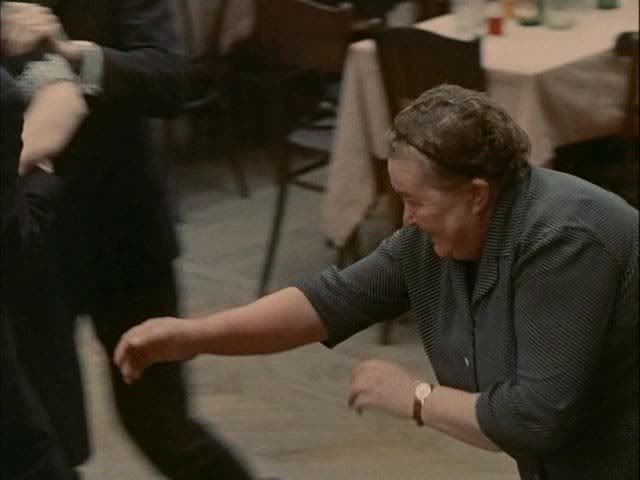

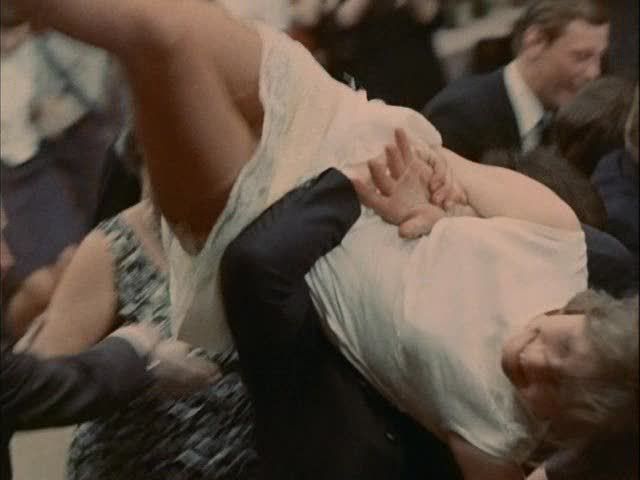
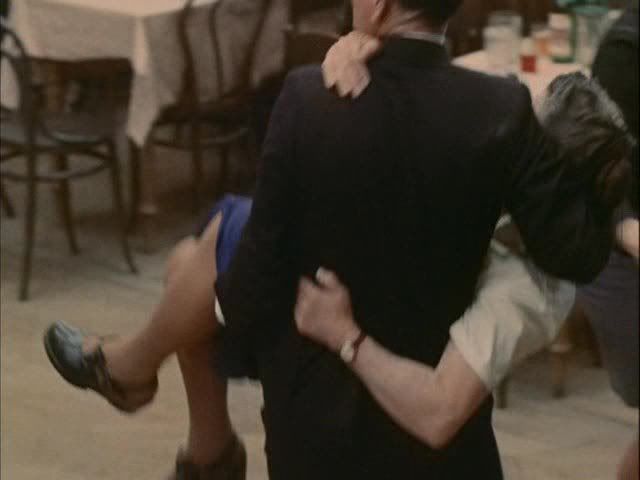
Forman then cuts to another of his shots of disconnected bodies, the heads chopped off and unseen. In this shot, the man swooping up the woman in his arms always keeps his face turned away from the camera as he spins with her. The woman's face is hinted at, glimpsed briefly from around the man's arm, which mostly obscures her from view. Individual identity is continuously deconstructed and subverted in the film, as Forman tends to view people in the abstract, as symbolic representatives of groups and ideas rather than as individuals in their own right. This deinvidualization is superficially aligned with the tenets of Communism itself, but Forman's concept of the crowd is more subtle and ambiguous. On the one hand, he stresses the dehumanizing effect of such representations, critiquing the Communist understanding of individuals — and yet his crowds are also the site of anarchic communal energy and celebration. This dialectical tension between positive and negative interpretations of "the masses" runs throughout both this scene and the film as a whole.

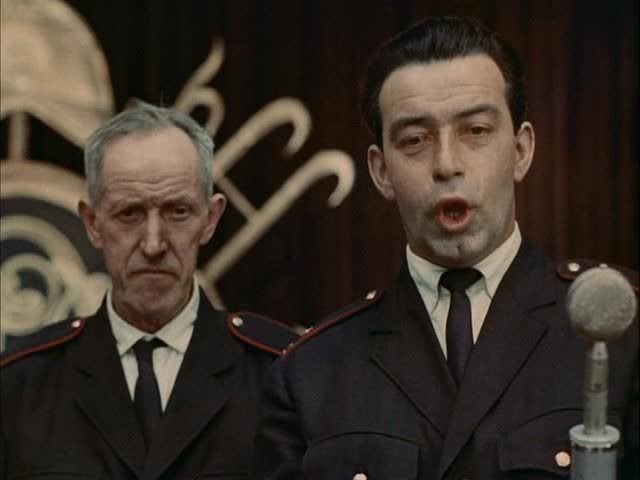
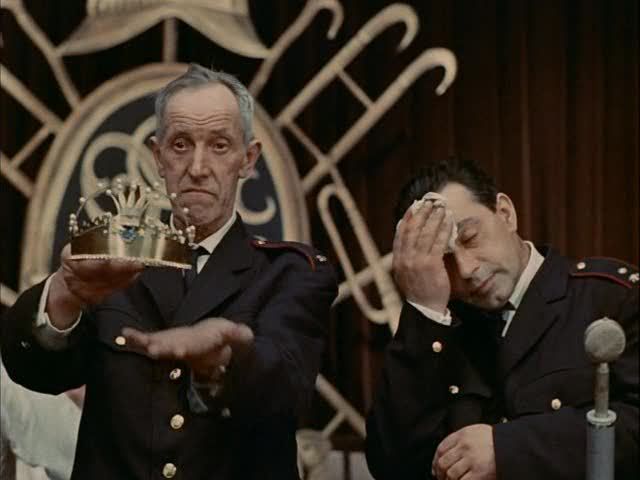
Another cut back to the stage, where the announcers are growing tired of waiting for the chaos to settle down — and resigning themselves to the growing certainty that it never will subside anyway. Their authority melts further away each time Forman cuts to them, as they appear more and more frazzled with each shot. The next time Forman cuts back to the stage, later in the scene, the announcers are gone altogether, and they've left the crown lying on the stage unattended. In this film, the powers in authority have essentially abdicated their right to this authority through abuse and incompetence. On one level, the film is about the (rightful) loss of faith in sources of authority and order, and the by turns liberating and destructive chaos that results.

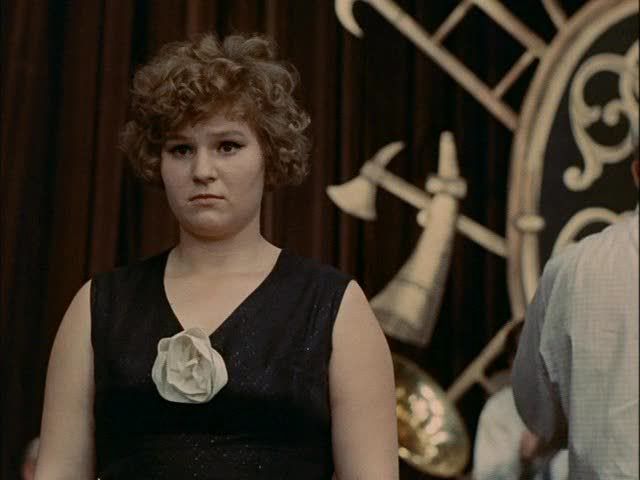
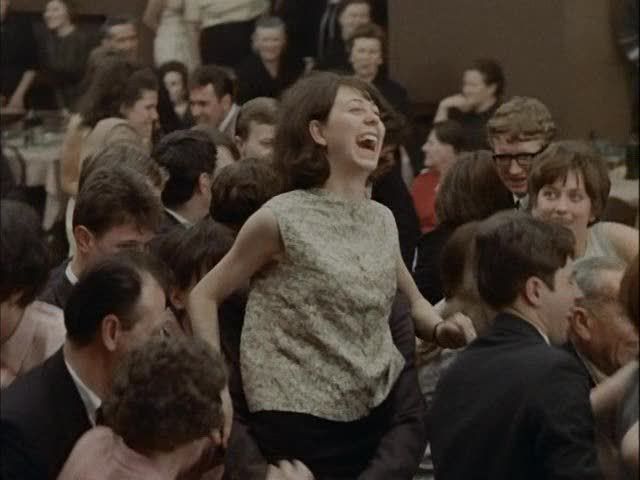
More wild fun in the crowd, a rare moment in which Forman privileges a woman's reaction amidst all this chaos, without chopping her up into her constituent parts. I'm not too sure why, but this girl at least seems to have been spared this treatment throughout the scene, as she appears several times, always with a greater than usual emphasis on her individual reaction. This is one of the elements that complicates Forman's understanding of communal representations — within his crowd scenes are reminders like this (and the shot of a girl looking out from between undifferentiated heads that I discussed in the first part of this article) that every crowd is composed of individuals, who occasionally demonstrate their individuality even in an amassed context like this.

The next three shots depict another breakdown in the scene's steadily disintegrating order. The one holdout from the beauty contest, the one girl who went up on stage — and also one of the few characters who is even given a name in this thoroughly homogenized society — finally decides to flee the stage. Earlier in the scene, her terrified, deer-in-the-headlights gaze was ambiguous, possibly caused by either the stage fright of being involved in the beauty contest to begin with, or by the confusion of the escalating riot heating up beneath the stage she's standing on. At this point, it becomes clear that her primary fear is the beauty contest itself, which places her in the public eye, probably for the first time in a culture built on crowds and groups.

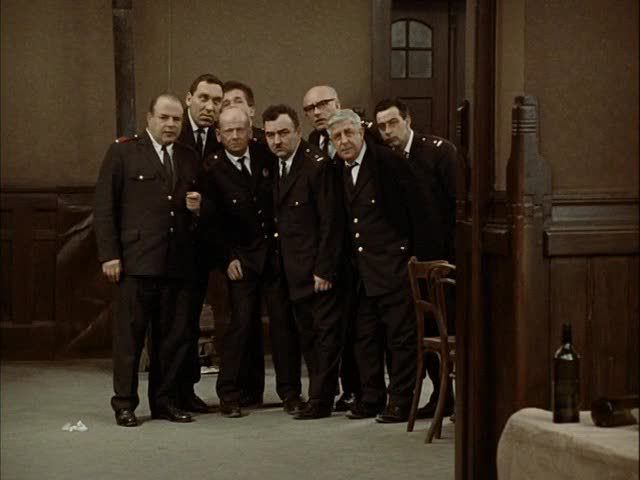
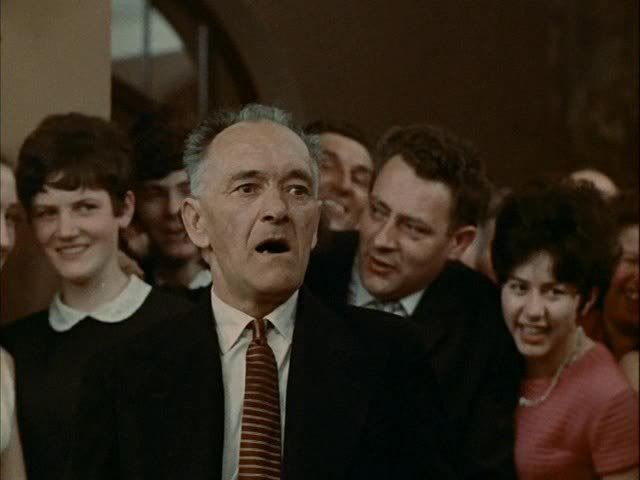
Forman frames her flight with two male reactions to it. First, there's a shot of her father, who bullied her into the contest and begged the reticent firemen to include her, despite her rather obvious homeliness. His stunned, horrified reaction appears before we're quite sure what it refers to, and then in the second shot Forman traces the girl's mad dash to freedom in a stunning, rapid right-to-left tracking shot. She starts at the extreme right edge of the frame, running frantically across it as Forman's camera races to keep up with her, turning the background into a blurry smear behind her. In fleeing the spotlight, she makes herself the center of attention for a little longer, briefly the only individual singled out from the bleary crowd image. Forman follows this bravura pan with another static reaction shot, this one of the whole group of firemen, who share her father's chagrin.
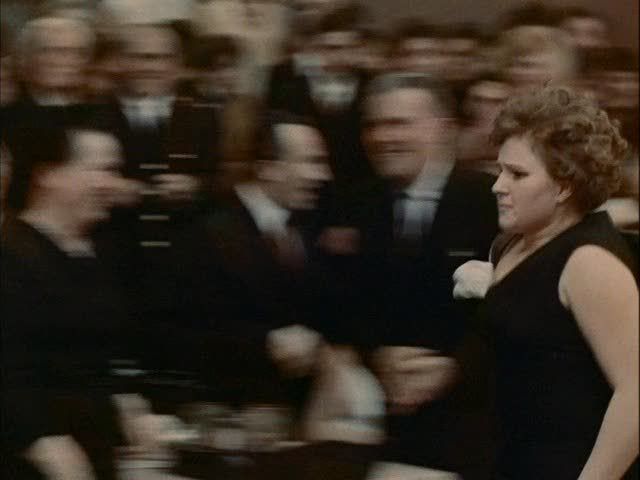


This is followed by a sequence that leaves the main ballroom behind in order to trace the explosion of anarchy beyond the confines of the main room, as crowds flood out into ancillary areas and outside the meeting hall altogether. The cheerfully fleeing girls running upstairs to the ladies' room are confronted by one stern representative of the patriarchal order, in the form of the bald fireman who resolutely but vainly attempts to block the girls from running any further. The direct confrontation of the rioters with the forces of order results in victory for the forces of chaos, as they push past the fireman to get to safety. It's probably relevant, in the context of this film's theme of female sexuality, that the refuge they're seeking is an exclusively "women's only" area, one seemingly so sacred that the firemen never even think to violate it — their only recourse is to try to prevent the girls from entering the bathroom, not to enter it themselves and bring them out. This is also resonant with the obliviousness these men display about female sexuality, a cluelessness and hesitancy that borders on fear.
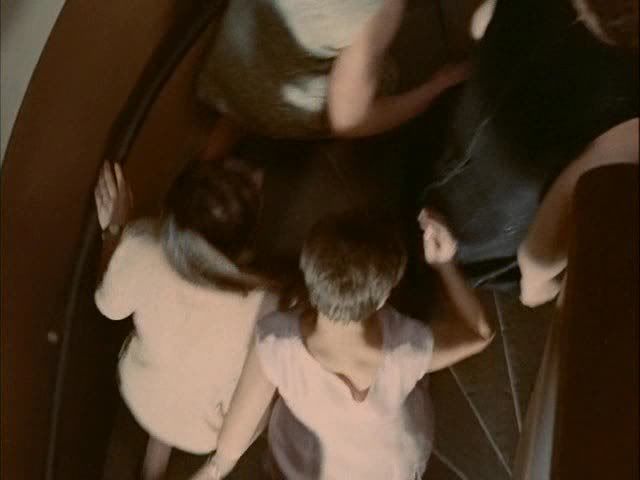


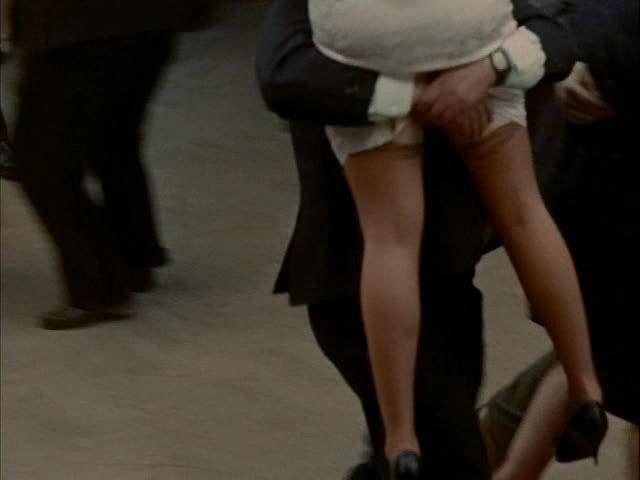
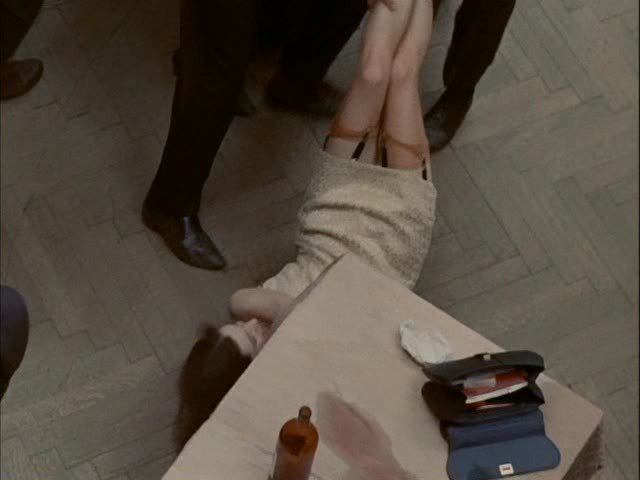
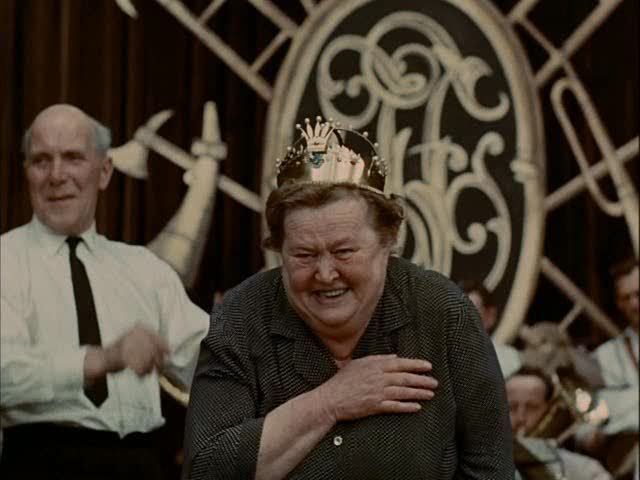
Forman then cuts back to the main ballroom, for one of my favorite shots of the film, and one that is perhaps most resonant with the subtle undercurrents of sexuality and individuality that flow through this scene. In her comments on the first part of this article, Marilyn Ferdinand mentions this later shot, saying: "Forman's peep show returns part of a woman's sexuality to her (I was particularly taken with the woman whose skirt rides up, revealing her stocking garters), but defines it in terms of the male gaze, particularly since the men are pushing the women around." This astute analysis of the forces at work here goes a long way towards clarifying what Forman is getting at in regards to Communism and the treatment of women. I think it's correct to say that Forman's sexualization of women is an attempt to free these women from the dehumanizing conformity of the mob, and that nevertheless this step towards liberation is compromised by the ogling male gaze of the firemen who judge these women by attempting to break them down. The firemen view women as assemblages of sexual characteristics, not as people, and Forman's camera frequently reflects this, commenting upon the lack of sexual and human imagination in these men. Even so, flashes of messy individuality and sexual liberation shine through: in the laughing girl carried aloft through the crowd, in the old woman who is, later in the scene, crowned beauty queen by the rioters, and in the garters that set this girl off from the anonymous crowd around her, even as she's unwillingly dragged into the mess along with them. Forman's mise en scène and framing generally confirm the prevailing anti-individualism of this culture, in order to better satirize it, but his sense for telling details continually undercuts and interrogates the assumptions of the firemen and the culture they represent.

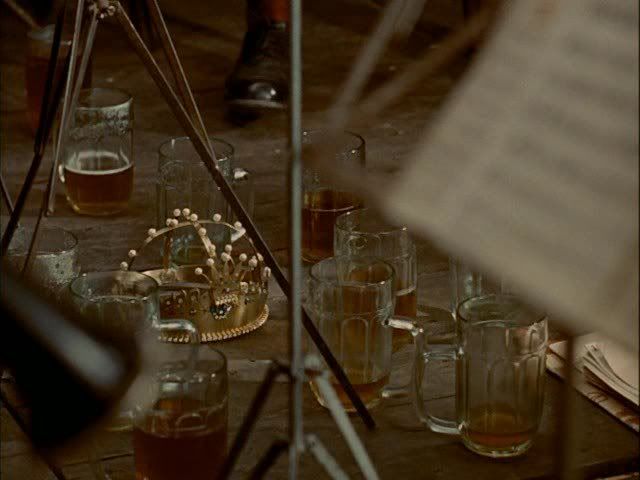
There follows two more shots in which Forman once again drives home the profound loss of patriarchal authority in this scene. The first is a cut back to the stage which simply reveals that the announcers have departed since the last time Forman showed them, sweating and despairing. They've left the crown on the floor, amidst the wreckage of the celebration, and Forman's tight closeup on the crown is a reminder of the origination for this chaos, as well as a stand-in for the absent male presence on the stage. The second shot is another visit to the area outside the women's bathroom upstairs, where all the gathering forces of the firemen prove insufficient to coax any of the women back outside. The result is a pile-up of would-be authoritative figures outside the door, helpless to do anything other than amass themselves in an ultimately meaningless array. It's here that the firemen will, during a gap in the din, soon hear the telltale whining of a siren that calls them to action in order to fight a fire — which is, ostensibly, their whole reason for being in the first place, and at which they prove to be as inept as they are at staging a beauty contest or planning a party.


The final two shots highlighted here economically convey the essence of the scene, and of Forman's approach to this material. The shot of the crowd gathering together resolves the chaos of the preceding scene into a new sense of community, one forged from anarchic fun and destruction. Forman's wide view de-emphasizes the individual more than ever, melding each person into a whole crowd that fills almost every available inch of the screen. Just as the fleeing beauty contestants signaled the end of order as defined by the patriarchal, Communist firemen, the scene ends with the rioters crowning their own beauty queen instead, one selected from the mess of the crowd. The connotations of this moment are, in keeping with Forman's overall satirical viewpoint, somewhat ambiguous — are the rioters coming together in a meaningful way, or simply replacing the old communal order with one of their own, that merely eliminates the role of the individual in different ways?

Tuesday, August 5, 2008

Solidarity in character

This is my first actual post on the blog for a few reasons. I wasn't able to get the last film between Netflix and the Virginia Tech library (which does have a pretty good selection) but also because the first film brought some pretty intimidating posts. I studied film as my concentration in undergrad and have done some research on film as a grad student thus far, but it seemed like most of the contributors for The Emperor's Naked Army were very well versed in the filmmaker and much of the history behind the film. That said, I decided to no longer worry about that. The idea behind this blog is great and I'm just going to contribute as much as I can with my limited experience.

Enough of that. I watched The Fireman's Ball last night and laughed my ass off the entire time. Simply as a comedy, Forman did an incredible job. The facial expressions on the bald fireman alone (especially while dancing in the circle of marching beauties) were worth the price of admission.

Besides enjoying it purely as a comedy I was impressed by the use of comedy so well as a tool for political expression. Ed's post is great at showing how much of this there is only in one scene. The thing that struck me last night was also the lack of individual identities throughout the film. Some of this might be because I was relying on subtitles, but I don't think it's all that.

There were some individuals which stood out. The 86 year-old former chairman is one, as well as the victim of the fire and Ruzena's father. Other than that, it seemed that the more important identity of most of the characters was the group they were a part of. Some firemen were more recognizable and more important, but they were most importantly part of the fire brigade. This is accentuated more when one of them chastises another for returning a stolen lottery prize by saying that the reputation of the brigade is more important than any honesty.

Similarly, most of the party goers seem to be more important as members of the crowd than individuals. The symbolism of the groups is fairly clear. The firemen are the authority trying to maintain control and run the system (however poorly) and the crowd as the people -- who steal and end up in a state of chaos. When the fire breaks out and everyone rushes out to go watch, workers at the ball attempt to collect on bills, but because of the disorganization of the system and the force of the mob this is almost impossible. Once outside, the manager of sorts continues to go around to people, but it's clear that the system has failed in the goal of collecting on all the bills.

A trip to IMDB confirmed this sense of collective identity as the primary one (at least as one of Forman's tools) as most of the cast members listed are named only as "committee member" or "'Miss' contestant." This most reminds me, of course, of Eisenstein's Battleship Potemkin. I haven't seen many films from Russia or the (now former) USSR made before 2007's Night Watch, so this was the biggest connection I could make.

The use of collective characters, whether purely a result of soviet montage's influence or only influenced by it, not only makes the symbolism of each group stronger. It also makes the comedy stronger. Because I don't have to remember faces for names mentioned in the dialogue I'm able to concentrate on, and better appreciate, the wonderful action and interaction of each group involved in the beautiful chaos that Ed described so well.

Watching Fireman's Ball definitely makes me want to seek out Forman's other films, particularly The Loves of a Blonde, to see what his overall style is like. Great choice, Marilyn, and I hope to keep active in this community.

Wednesday, July 23, 2008

Chaotic Bodies: The Firemen's Ball Beauty Pageant (part 1)

In The Firemen's Ball, Miloš Forman makes extensive use of a very crowded mise en scène in order to make his points about the absurdity and chaos of collective action in socialist societies. His frames are frequently packed with people, often moving rapidly and creating chaotic compositions that reveal isolated body parts and motion-blurred imagery. And yet, although Forman is attempting to capture the sense of chaos, his compositions still have a certain formal logic to them that defies their snatched-on-the-fly quality. This is especially true in the film's sublime beauty pageant sequence, a hilarious set-up in which the contestants all flee while the men in the audience attempt to capture them and, eventually, begin dragging entirely unrelated women on stage as well. This scene is particularly well structured despite its chaotic appearance, and Forman's formal and thematic concerns show through even in the most seemingly tossed-off visuals from this sequence.

For this reason, I wanted to do a close analysis of the beauty pageant scene, breaking it down shot by shot in order to discuss what Forman is doing here. My starting and ending points within the scene are fairly arbitrary: I start after the first contestant runs off, sparking the riot, and cut off slightly before the sequence's true end when the firemen hear the siren going off in the midst of the disorder. In between is one of the film's most rapidly edited and frantically paced sections, a masterpiece of madcap comedy where everyone looks like they're having a blast just filming it. I've broken this down by taking a single screen capture from each shot in this segment, in order to illustrate the ways in which Forman's seemingly unhinged depiction of the chaos at this party is actually built up from a meticulous sense of editing rhythms and an eye for striking compositions even within a frenzied environment.

The first shot of this sequence is a cut back to the main room after a (very funny) brief scene upstairs, where one of the committee members was attempting, in vain, to catch two of the contestants as they fled into the ladies' room. This shot introduces the more frenzied section of the scene, as the main ballroom degenerates into total chaos and the guys attempt to drag girls kicking and screaming onto the stage for the beauty contest. I've only selected one screen capture per shot here to keep this from being too long a post, but each of these individual shots changes quite a lot from one frame to the next, with the camera frequently swinging along to follow the actors in their rapid motion. These shots seldom settle into static compositions, but I think even these single frame grabs provide a sense of the movement and energy of this scene.


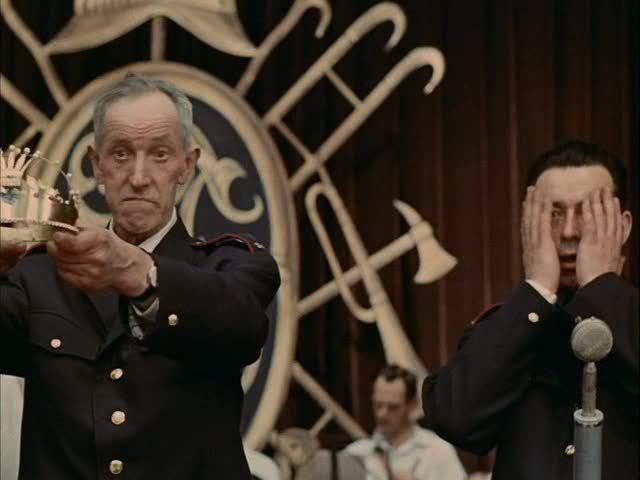
In contrast to the chaos of the party itself, the periodic shots of the announcers on stage are very static and stylized. Throughout the film, Forman maintains a rigid distinction between the way he films the brigade leadership (who represent the Politburo) and the people at the party (the proletariat). As in this shot, the committee members are inevitably presented with a somewhat distanced, formal quality that makes them seem especially absurd in the context of all the disorder surrounding them. Throughout this scene, in particular, the periodic shots of the announcers are islands of stability in a shifting sea. But this stasis does not have a positive connotation in any way. They are static, not because they are stable, but because they are helpless, paralyzed by the complete loss of control over what's happening. Forman is much more sympathetic to the wild partygoers who embrace anarchy as a response to their inept leaders; even if he sees this chaos as another symptom of a system out of control, Forman understands the urge to disorder when faced with such incompetently managed order.


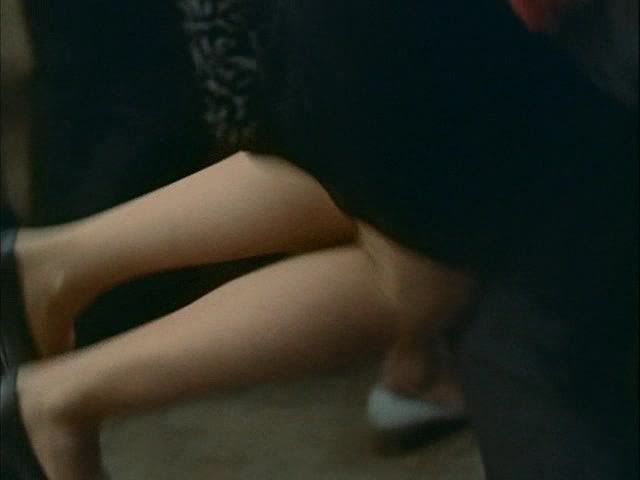
One of the characteristic features of this sequence, and the film as a whole, is the way that Forman frequently breaks down the body in shots that emphasize human movement and the awkward, messy exigencies of body-on-body contact in tight spaces. In this case, of course, the tight space is mainly the constriction of Forman's own frames, which are usually surrounding quite a few people. The next four shots are briskly edited together with lots of camera movement, as well as people moving very quickly within the shot. These shots are also mostly focused below the waist, with legs figuring in very heavily. Forman seems to have a fascination with women's legs that goes beyond mere sexualization. The focus on legs here is linked with the sequence's locomotive sensation, honing in on straining leg muscles and legs in various positions of flight and maneuvering. The scene might even be read, with some admitted stretching, in proto-feminist terms, whereby the legs that men viewed as sexual objects (the committee members got down to ground level in an earlier scene to check out the gams of prospective contestants) now become the means of flight from a demeaning beauty contest.


The next shot cuts back to the face of the one contestant who is actually standing on stage at this point, the first girl to go up, not because she was particularly bold or untroubled by the process, but because her father literally pushed her into it. These periodic cuts to the stage throughout this scene are moments of stasis, providing a contrast against the rowdiness of the crowd. This stasis is fleeting, though. As the scene goes by, the stage becomes less and less reliable as a source of safety from the rioting masses: the one contestant on stage makes her own flight from the pageant, the announcers finally give up and sit down, leaving the crown on the ground, and finally the rioters themselves take the stage, crowning one of their own in a triumphant end to the festivities.


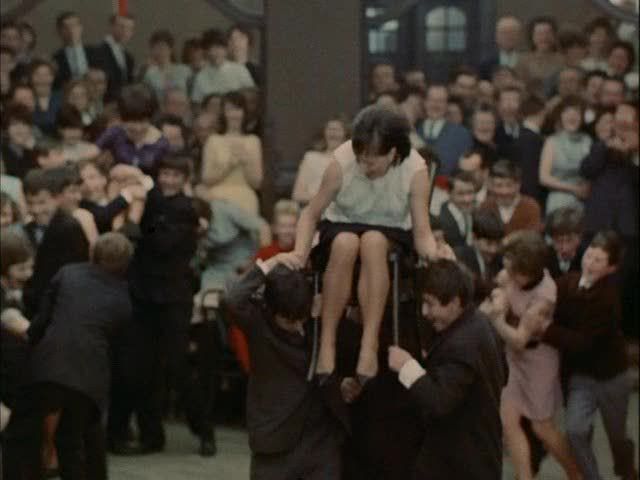
Forman next cuts back to the crowd, with a long shot of a group of guys lifting a laughing girl up onto a chair, followed by another close shot that emphasizes a woman's legs as she's carried around somewhat awkwardly.


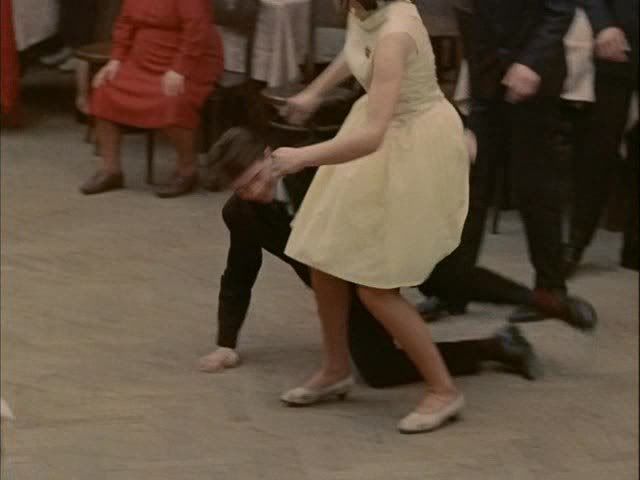
The camera cuts back to the increasingly frustrated announcers, who by now are getting tired of holding the crown aloft awaiting its recipients, and who are on the verge of giving up for good. The slightly low angle of these shots, and the grandiose decorations on the stage behind them, sets up these figures as sources of authority, clearly placed on a higher plane than the audience. The joke is that their supposed authority turns out to be empty flourishes, as the contestants refuse to obey them in coming up on stage, and they can't even get the band behind them to keep playing without taking a break for beer — an unfortunate pause in the music that unfortunately gave the contestants just the excuse they needed to break loose in the first place. This brief shot of authority collapsing into acquiescence is followed by another of the scene's characteristic shots of men and women scuffling in the crowd. These shots are taken from ground level, keeping them at the level of the rioters' legs, thus signaling the disparity between the higher authorities and the common people below them. In this particular shot, the two people in the foreground briefly clench, then come apart as the woman pushes the man to the floor, the camera shaking slightly downward, cutting off her head and focusing more on her legs as the man's fall is completed.


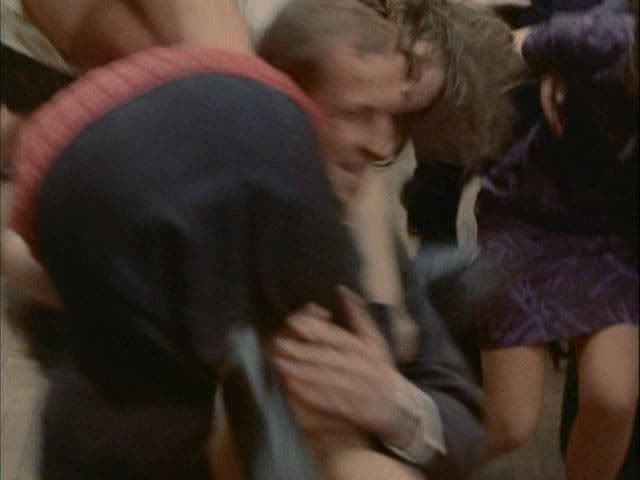
Forman's attention to legs is at times matched by the impression he gives of a sea of anonymous heads forming a monolithic crowd. Part of the film's critique of collective action is the way it captures the loss of individual identity in large masses, and the crowd scenes frequently point out and comment on this anti-individualist aspect of groups. It's easy to see this de-individualization in the many shots of legs, feet, and torsos, disconnected from their owners, but Forman's critique is every bit as implicit in the shots that show heads and faces. Even in these shots, individual people are given only fleeting representation, their faces glimpsed momentarily and then lost in the sea of undifferentiated bodies around them. Forman's frame is frequently obscured here by cloudbursts of frizzy hair and blurry, indistinct outlines of the revellers' heads. The occasional recognizable individual, like the laughing girl in the second shot below, seem to be peering out at the camera from a great distance, lost in the swirling, non-stop motion of her surrounding comrades.


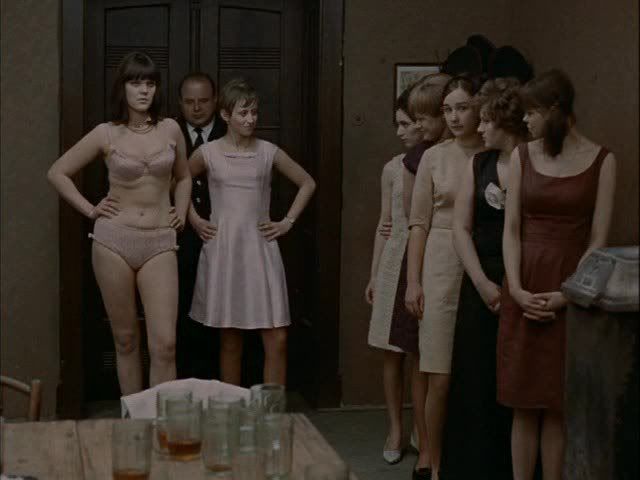
Another subtextual undercurrent in this scene is the way in which Forman treats parts of the female body usually associated with sexualized depictions, especially when they're emphasized as much as they are here. In another film, it would be hard to view an extreme closeup of a woman's butt as anything other than the most blatant of sexual exploitation on the part of the director. Forman's perspective seems to be quite distinct from this crudely sexual viewpoint. Throughout the film he points out the sexualization of women's bodies in wry, ironical ways, not at all sympathizing with the leering gazes of the firemen but instead pointing out their objectification. During the scenes where the committee members are picking their contestants, Forman continually mocks the ways in which these ridiculous men size up the women like cattle. There's a hilarious scene where the men can't decide which part of the women's bodies to look at, so they first circle the ballroom ostentatiously staring at the girls' faces, then they go up on a balcony to check out bust sizes and cleavage, and finally they're crawling around on all fours at leg level. This tendency to ridicule the men for their libidinous gaze is carried over into the scene where they make the women line up in formation, barking orders at them, and finally make them march in circles. During this drill-like pageant preparation, Forman's camera drifts down to chest level, focusing on the breasts of the women as they circle in front of the camera's stationary position. This camera placement isn't meant to give the audience any gratification, but to draw attention to the perspective of the men who are watching this spectacle; Forman simply shows us what they're seeing.

The similar shots in the context of the riot scene are not as obviously satirical — there is no observing male viewpoint for Forman to mock in this case — but they nevertheless serve a similar purpose by drawing attention to the way that the men attempt to violently, forcefully round up the women for the pageant, as though they're herding animals rather than recruiting contestants. The focus on the women's physicality, as they gleefully avoid capture, thus emphasizes the parts of their bodies that invite male attention, while simultaneously subverting this attention with the overall thrust of the scene.


Continue reading this article with Part 2.

Monday, July 14, 2008

The Firemen's Ball: Two Visions of Collective Action

[This is cross-posted at my blog Only The Cinema. This is my general review of the film, an overview of its themes and visual strategies. I plan to write more in-depth about a few specific scenes later in the month.]


Made just before he left Czechoslovakia for the US, The Firemen's Ball was director Miloš Forman's first color film, his final film in his native country, and also the reason he had to leave his country in order to continue making films. It's easy to see why. The film is, quite obviously to both modern audiences and, apparently, Czech censors, a thinly veiled critique of the Czech Communist Party and, more audaciously, of the very idea of collective action that underpins socialism. This is a deadpan, hilarious satire, documenting a single night at a small-town party organized by the local fire brigade, honoring their retiring chairman on his eighty-sixth birthday (they missed honoring him on the more meaningful eighty-fifth, a year earlier, in the first of many fumbles committed by this incompetent assemblage). From the very beginning, even before the credits, Forman sets the scene for the idiocy to come, as the firemen accuse each other of stealing the prizes from the night's lottery fund, and set fire to the banner that was to hang above the hall during the ball. The fact that they're unable to even operate the equipment to put out this small-scale blaze is both the first comment on the extent of their incompetence and a bit of foreshadowing for the film's surprisingly poignant climax.

Of course, things only get worse from here. These are men who can manage to screw up the process of selecting beauty contest participants in what seems to be a ballroom positively crammed with attractive young women. Their chosen finalists are either aggressively plain or exaggeratedly awkward, like the girl who pads her bra to such an extent that her dress seems to be held away from her body on tent posts. Forman simply lets absurd scenarios like this play out in natural ways, sticking with this anonymous and ridiculous committee as they bungle their way through every aspect of the party's planning. Over the course of the evening, the table piled high with lottery gifts is slowly emptied by multiple (and unseen) thieveries, young couples copulate under tables, the chairman seems senile and lost, and keeps executing a slow, stately walk towards the stage at completely inappropriate moments, and the beauty contest itself falls apart, in one of the film's most hysterical scenes, when the contestants all get cold feet and begin fleeing.

Forman stages all this in an atmosphere of rapidly escalating chaos, as the party spirals completely out of control. His camera is intimate, casual, and perfectly attuned to the spirit of anarchic insanity running throughout this room. Indeed, Forman often seems to be taking gleeful pleasure in the lunacy going on everywhere. His mise en scène encompasses, essentially, two different visions of collectivity: the ordered committee action of the party organizers, and the wild, unfettered anarchy of the party itself. For Forman, both of these possible outcomes are equally absurd, and both are clearly tied to aspects of Communist society — just as the fire brigade stand in for the Communist Politburo, the partygoers are the proletariat, trapped within an absurd situation with absurd leaders, and forced by these circumstances to act in dishonest and despicable ways. This is a system that privileges dishonesty. Confronted with the fact that all the lottery prizes have been stolen, the fire committee decides that the people who didn't steal will just have to think of it as if there was a lottery and they didn't win. After all, everyone bought tickets; those who stole the prizes were simply the winners. When one of the committee members has an unusual attack of guilt and is caught attempting to return a stolen prize, his comrades are angry at him, not for stealing (that's expected), but for trying to return the prize, thus damaging the reputation of the fire brigade.


Forman's framing of the fire brigade inevitably enforces the point that they are nominally in charge but crippled by their indecisiveness, incompetence, and corruption. The group is almost always photographed together, seldom with the members isolated from one another for any length of time — the exception is when the one member has his moment of repentance. Most of them are not even given names. They are anonymous figureheads, an idealized group that acts together with no trace of individuality. Or so goes the Communist theory, Forman seems to be saying wryly. In practice, his head-on depictions of these men, massed into groups, projects an image exactly the opposite of the unity and collective action that is the ideal of socialist politics. As they cluster into tight formations, staring tentatively and fearfully at the camera, they look lost, like scared individuals trying to hide within the safety of a larger group. Forman's perspective, his deadpan camera angles and his objective distance from the assembled old men, gives them a pathetic quality that's heightened, not lessened, by their collectivity. It's this subversive questioning of collective action that is most radical in Forman's film, and is probably what the Czech censors responded to the most ferociously, even if it only registered with them subconsciously.

Not that "the people" make out any better here. The leadership may be idiotic, but the people they're leading are stubborn, unwilling to be led, and forthrightly dishonest. If Forman's vision of committee leadership is marked by its static angles and clustered compositions, his party scenes have a wildness and spontaneity that presents the reverse of this rigidly absurd group leadership. These scenes are chaotic accumulations of bodies whirling and flying past, often broken down so that only body parts can be seen. Individual shots focus on the legs of the dancers, or their arms and torsos in the midst of a frenetic riot, or their amassed heads in a sea as they listen to a speaker on stage. Best of all is the complete breakdown of order that accompanies the beauty contest, as the contestants run away and the crowd quickly degenerates into chaos, with crowds of guys attempting to corner the women and drag them on stage, throwing girls over their shoulders, even roping in girls who hadn't been in the contest to begin with. It's a masterpiece of completely unrestrained society, "the people" breaking loose of their inept masters and having fun watching the destruction of their social order. But Forman's editing in this scene is also surprisingly crisp, his images maintaining the perfect economy of his more structured compositions even when the stampeding revelers seem to be disrupting any semblance of order. Forman's portrait of disorder is perfectly conceived, achieved with a natural sense for visual rhythms and purely visual humor.

The Firemen's Ball is a delightful film, but also a film with a very serious heart beating beneath its surface humor. As the film's climax reveals, the incompetence of the fire brigade, which seems so comical in the context of a disastrous party, can also have serious consequences when applied to real world matters. When these bumblers are placed in charge of not a beauty contest but of public safety, the true extent of their bumbling, and its horrifying results, becomes readily apparent. This is why the sequence of the old man's house burning, placed where it is within the film, is so heartrending. As Forman cuts precisely back and forth between shots of the consuming, brilliant fire and the emotional faces of the observing crowd, the hopeless non-efforts of the firemen to extinguish this blaze are not funny, but incredibly depressing. The same could be said of the later scene where the committee members even bungle the presentation of an award to their former chairman, who is now dying of cancer. This old man's quiet dignity and patience in the face of the evening's many disasters make a mockery of the committee's ham-fisted attempts to honor him. A decent man in a corrupt system, he is entirely out of place here, and he becomes a victim as a result. This is a hilarious film, but its humor is cut with bitter satire, with a deep disgust for the absurdities of the political system of Czechoslovakia at the time.

Sunday, July 13, 2008

I Laugh at Danger! Milos Forman and The Firemen's Ball

by Marilyn Ferdinand

I went to my dentist's yesterday. I’ve been seeing Dr. Hamilton for more than 25 years and always assumed from his accent and attire that he was German. I got a real surprise when he revealed that he was Czech and had grown up in Prague, a couple of blocks from the old city square, just around the corner from where Franz Kafka grew up. Naturally, I couldn’t believe the serendipity of learning my long-time dentist was Czech on the same day I planned to write my FOTM Club post on The Firemen’s Ball. We talked about Miloš Forman, and Dr. Hamilton related some fascinating film and moviegoing experiences he had had in Czechoslovakia. He said he had a great story for me:

There used to be a tank on a pedestal in Prague that was supposed to have been the first Soviet tank to move into the city to liberate it from the Nazis. “Naturally,” Dr. Hamilton said, “It was a propaganda lie. The Czechs rose up against the occupying Germans as Berlin was falling and drove them out themselves.” When he went back to Prague after a 25-year absence, he asked his cab driver if the tank was still there. “Oh no, that’s long gone,” the cabbie said. When the Communists were falling, the Czech citizens stole into the night and painted the tank pink. The Russians were so embarrassed, they took it down—pedestal and all!

I couldn’t have had a better picture of the Czech spirit, as explicitly captured in The Firemen’s Ball, if I painted it myself.

The Firemen’s Ball was the last film—and the only color film—Forman made in Czechoslovakia. The warm reception of his second full-length feature, The Loves of a Blonde, helped convince producer Carlo Ponti to provide the financing that made color shooting possible. Forman and his creative partners, Ivan Passer and Jaroslav Papousek, holed up in a small Czech town to concentrate on writing the screenplay. After days of producing one bad scenario after another, the men decided to relax their minds at a firemen’s ball being held in the town that weekend. Afterwards, the ball was all they could talk about. Thus, The Firemen’s Ball was inevitable, and they were able to enlist many of the actual firemen and people in the town to appear in the movie.

When Ponti saw the film, he hated it so much that he exercised his right under his contract with the Czechoslovakian government to have his $65,000 returned. Forman faced 10 years in prison if he could not pay the government back; fortunately, he was able to show the film to Claude Berri and Francois Truffaut, and they paid his debt. Nonetheless, the government banned the film; it was unbanned for a few months in 1968 when Alexander Dubček came to power and then rebanned forever from its native screens—how absurdly Czech!

What was it about this film that Ponti and even the more relaxed Communist government of the 1960s so despised? It made fun of the proletariat! While there’s no question that the Czech people come in for some ribbing—donating raffle tickets for odd prizes that are slowly disappearing from a “guarded” table to a man who has just lost his home in a fire—the disorganized system of committee rule and the obedient functionaries of Communism are the main targets.

It’s not hard to see how the board of the firemen’s association is a stand-in for the Politburo that can’t bring order to chaos or basic goods and services to the people. Along with the party goers, we watch “Granddad’s” home blacken and burn because the fire truck is stuck in the snow; meanwhile, the capitalist ballroom owner walks through the crowd collecting on bar tabs and sets up a table from which to continue to sell drinks.

I am perhaps most intrigued by the 86-year-old former chairman of the firemen’s association who is to receive an award—a miniature, engraved axe—for his dedicated service over the years. It is to be presented by the winner of an impromptu beauty contest that, due to its runaway contestants, never takes place. The old man starts a straight, dignified walk toward the stage as the first contestant is called. He must be called back. He sits. He waits patiently as one disaster after another befalls the committee and the ball. At the very end, he alone remains in the trash-strewn ballroom. The committee hastily retrieves the box containing the award and decides to present it themselves. The old man moves forward, takes the box, and recites his carefully prepared and somewhat lengthy speech. When he opens the box, he finds the axe has been pilfered, too.

This old man is something of an enigma to me. He’s certainly the loyal Communist who comes up empty-handed in the end because of the of the system’s misshapen supply-demand curve. He’s also a leader blind to everything but his own role, the perfect bureaucrat in a broken chain, as well as a man (system) who is dying of cancer who has not been told he is ill. Finally, of course, he is an ordinary citizen who is degraded by the petty thievery of an item that can mean nothing to anyone else. This theft is both humorous—a raspberry in the face of the leadership—and a sad way for a fellow human being to be treated. Despite its high comedy, it’s no wonder the film has been called highly pessimistic.

The contemporary film movements from former Soviet Bloc countries—particularly Romania and Bosnia—identify with their traumas and open their veins. The Firemen’s Ball, though pessimistic, reflects the Czech sensibility characterized by an appreciation for the absurd, a howl of laughter in the face of danger. Forman, the only member of the Czech New Wave to have a highly successful career outside of his home country, has focused on some of his early concerns in other films (One Flew Over the Cuckoo’s Nest, Ragtime, The People vs. Larry Flynt) but without the giggles. I hope Forman finds a tank in the near future that needs a new coat of paint.