Curtis Hanson's Califor-noir
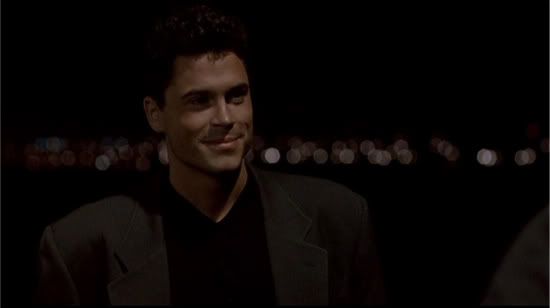
Bad Influence (1990) impressed me mostly as a "downlow" narrative of male-male courtship, depicting the peculiar perils of same-sex intimacy. I don't think I read the film as "gay" in any way. Nor do I find it especially homoerotic (despite the camera's lurid titillation by the seedier tinge of Rob Lowe's beauty).

Rather, what I find most interesting in
Bad Influence is Hanson's provocatively cinematic exploitation of queer(ish) visual tropes as a way to evince the essentially uncertain perils of male-male intimacy. I'm also fascinated by the fact that Hanson, presumably developing this film in the later 1980s, was able to make a film about the erotics of masculine intimacy while somehow eliding/escaping certitudes of gayness and/or straightness.

Most centrally, and putting aside for the moment the (open) question of whether or not Lowe's Alex is "real,"
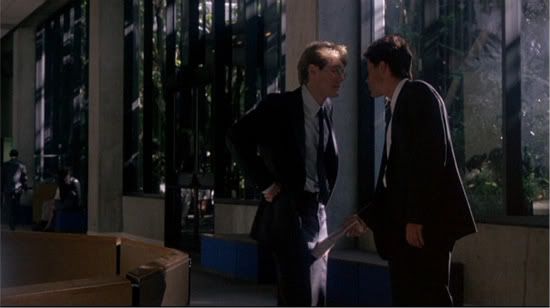
Bad Influence is "about" the relationship between Spader's Michael and Rob Lowe's Alex (if that is indeed his "real" name)...

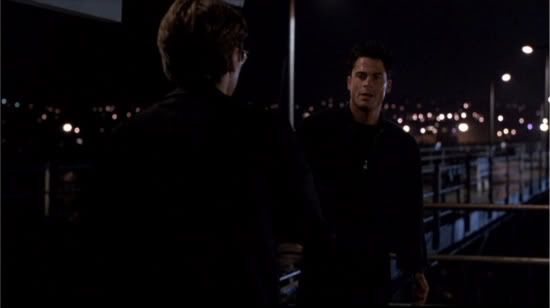
I love that the environment of Alex and Michael's first real interaction -- the piers, just after Michael has checked out the men's room and discovered it closed -- is a physical location rife with "cruising" metaphor.
And that their subsequent exchange -- a battery of awkward greetings, dropped glances, and coy smiles -- is as fraught as any flirtation, a feinting encounter that becomes all the more electrifying for the speed with which it evolves into a thrilling new relationship.

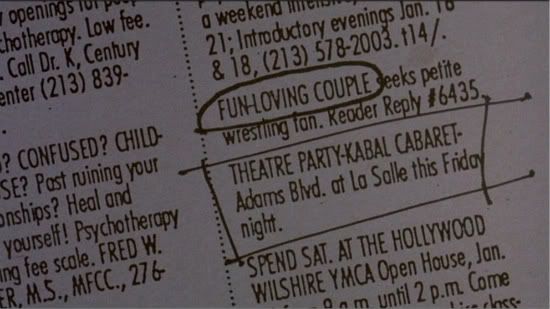
I found it impossible to forget the obliquely erotic charge of this first encounter between Michael and Alex, especially as their impromptu "date" continued, first to a dive bar where they seemed only to be interested in each other and then to an underground nightclub where their scopes widened. Here, I think it worth noting how Hanson uses the "code" of the underground nightclub network to mark the next three beats of Alex and Michael's evolving relationship.

First, it's a bit of role play, requiring a touch of subservience on the part of the masculine subject. And while I wouldn't go so far to say that Lowe's Alex
is the aforementioned "dominant athletic female" (though it is a somewhat amusing thought), I would suggest that the personal ad "code" does cue Spader's Michael for the "role" he takes in his subsequent relationship with Lowe's Alex. In the scenes that follow, Alex is calling the shots and Michael's learning the pleasures of taking orders. By the time of their next big night together, the two men have experienced a somewhat surprising degree of physical intimacy.

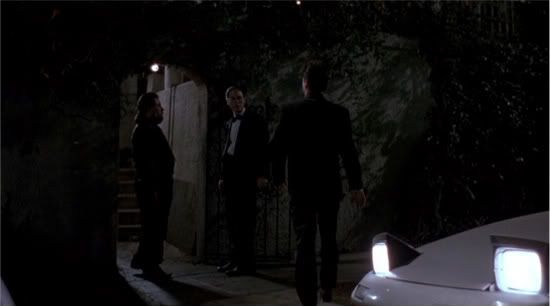
So it may be little surprise that Spader's Michael finds himself thrust into the throes of a minor identity crisis, as when he visibly bridles when Lowe's Alex voice calls from behind: "Gay White Male!"

Spader's Michael is, of course, visibly relieved to realize that "Gay White Male" is not his new title but (like "Dominant Athletic Female" before it) merely the "code" for Alex and Michael's next adventure. This moment, too, is when I become convinced that Hanson is using such "code" to underscore that Michael and Alex are getting a little
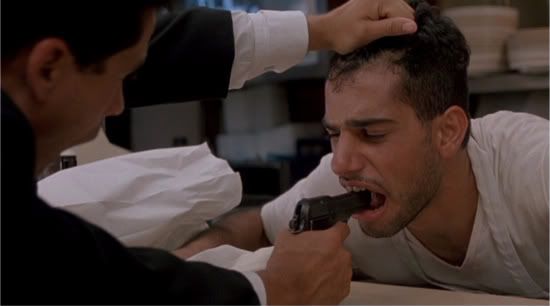
too close. Indeed, the "Gay White Male" evening of adventures commences a phase when things between Michael and Alex start getting scary, when their macho playdates transform into a set of dangerous secrets that Michael must learn to guard -- to "closet" -- lest they destroy the careful construction of his public persona. The homosexual horror of this next phase in Alex and Michael's evolving intimacy is enacted gruesomely, first in their shared predatory late-nite rampage (which includes the bizarrely sexual attack on the donut shop guy, an assault which culminates when Lowe doesn't "shoot" the dude's head off, but instead "squirts" in his mouth)...

And which continues as Alex stages his careful incrimination of Michael, a nefarious scheme which promises to render permanent their passing intimacy.

At this moment in the narrative, Alex's motives beg for elaboration, yet Hanson doesn't budge. Perhaps as a result,
Bad Influence becomes more interesting than it should be. And, for me, the unknowability of Alex's motives clarified the gendered operation of identity-theft noir pics more generally. At this juncture in the narrative, I found myself reflecting on the identity problems in movies like
Fight Club and
Strangers on a Train or, say,
Single White Female or
The Hand That Rocks The Cradle or
Rebecca. In this screening of
Bad Influence, though, I realized that the threat in female-centered identity surrogation noir is most often that of a kind of erasure, where the ominous figure (either the new friend or the absent predecessor) threatens to stealthily overtake the life of the central character, until she must fight back in order to protect her own integrity/personhood. In male-centered pics (like
Fight Club or
Strangers on a Train or
Bad Influence), on the other hand, the ominous new character is not so much about identity dissolution/displacement but more about the threat of unveiling a core, intimate truth about the male protagonist. (As when, here, Lowe's Alex taunts Spader's Michael with the breathy allegation: "I didn't make you do anything that wasn't in you already.") The thrill of male-centered identity surrogation films often follow from one man's choice to reveal his true desires to a charismatic male stranger and, subsequently, how this other man chooses to utilize this intimate "secret" to compel the protagonist to do terrible things. It's a fascinating, gendered tension -- identity dissolution versus identity revelation -- that I don't think I would have discerned where it not for the curious peril of masculine intimacy in
Bad Influence. It's also why, to my mind at least, why the third beat in Alex and Michael's relationship is cued by the final bit of personal ad "code": Fun Loving Couple.

While Alex has wreaked his desired havoc in Michael's life and is ready to move on (to a porny threesome with two women no less), Michael decides brings a third into the drama of his primary relationship with Alex. And not only is Michael's "third" a man, but it's Michael's brother Pismo (Christian Clemenson). In this moment, the model of masculine intimacy embodied by the Michael-Pismo dyad (a signal of the intrinsic, if imperfect, reliability of filial trust) stands in a conclusive contradistinction to the Michael-Alex dyad (an example of the perilous thrills of the mancrush). And, of course, with the normative masculine intimacy of his connection with his brother to moor his unsteadiness, Michael's relationship Alex ends where it began -- in the cruisy isolation of the pier -- with one man decisively communicating to the other who's on top.

All told, Curtis Hanson's
Bad Influence is a surprisingly rich exploration of the perceived perils of masculine intimacy and, in the best noir tradition, Hanson is somewhat astonishingly unapologetic in his use of queerish/erotic visual tropes to explore the uncertain terrain of male-male emotional infatuation.











 Posts
Posts


