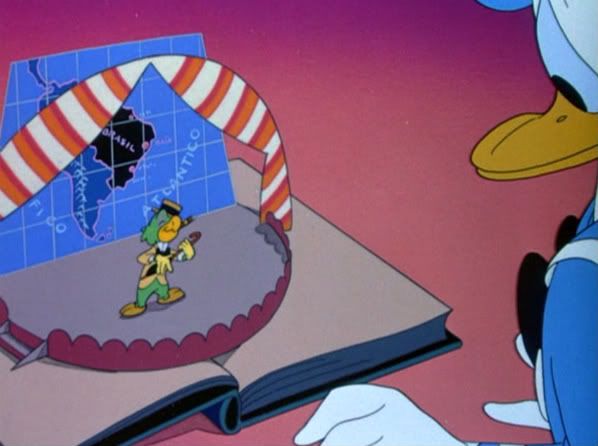
Sunday, March 29, 2009

Final Thoughts

Before the month ends and we move on to another film, I'd like to thank Chris for allowing me to choose this month's selection. Thanks also to Marshall for his comments and thoughts and to the few others who joined in. Although there wasn't a lot of discussion, I enjoyed what there was and I benefited from trying to articulate my thoughts on this film and on Hong in general. As many could probably tell, I'd like to write more on Hong in the future, in article or even book (especially if my Korean improves), and this experience was very useful in that regard. I hope others found the film and the discussion of some interest, or that perhaps they will track down this film or others by Hong in the future. I certainly think the films are worth the effort. And by all means, of course, I'd be happy to hear from late comers before the month is over or even in the coming months as replies to any of my Hong blog postings.

Also, in Hong news, he is currently in post-production on his latest film, which should be out later this year. Also, he has completed a short film which will premiere at the Jeonju film festival in Korea (April 30-May 8). It is part of a three film "Jeonju Digital Project" in which the festival invites three directors to make a digital short. Further details are available here (go to the JIFF news section and click on "Jeonju Digital Project 2009").

Monday, March 16, 2009

Two Shots That Intrigue(d)? Me

Just thought I'd mention a couple of shots that intrigue me, shots that are seemingly meaningless.

One is Munho going back and asking his wife to let him in at the beginning of the film:

Another is the shot of Seon-hwa arriving to meet Mun-ho and Heon-jun:

When re-examining the film, both of these moments seemed difficult to place. And perhaps, I thought, they are not meant to be. But, the more I thought and read, the more this seemed unlikely. In a film as pared down as this one (even by Hong's standards), it is highly unlikely that they don't serve some purpose. Then, with the mentioning of repetitions, I noted that both shots have their doubles.

The shots of Mun-ho are subtly replayed at the end of the film, when Mun-ho's male student Min-woo approaches Mun-ho and Kyung-hee in the hotel room:

And the shot of Seon-hwa arriving can be seen as a mirror of the early scene in which the woman Mun-ho and Heon-jun gaze at before their flashbacks finally exits the scene in a car:


Now, we can see these as formal repetitions that work as a whole to offset the quotidian realism of the narrative. And/or we can start analyzing these for deeper meanings. Part of me wants to avoid the later, to remain intrigued by the shots instead of forcing an explanation. I remember watching Lynch's Mulholland Dr. and really enjoying it, but then not loving the film nearly as much (to the point of even being bored) once I had a certain framework in which to read and explain what was going on. And the other hand, one cannot and should not shut down these critical impulses. One can only hope that any given film is strong enough to resist their assault.

Sunday, March 15, 2009

Staying Wide: Some random and disjointed [my apologies] thoughts on Woman is the Future of Man

(This may sound like a joke, but I have given up "going online" for lent. So this post was written weeks ago, and has been scheduled to appear in the middle of the discussion (hopefully!) of Woman is the Future of Man. Therefore, I hope I am not either repeating things that have already been posted, or interrupting a tremendously interesting post-by-post dialogue of a certain theme (not that anything like that has ever happened). Regardless, accept my apologies for both posting blindly and randomly and for not being able to continue any discussion that may result from this posting or any others. I hope you will understand.)
Thanks to Marc for getting me over my unconscious avoidance of New Korean Cinema. In fact, I have been actually avoiding, less unconsciously, Asian cinema as a whole for a while, I don't know why. Embarrassingly, I own only one Asian film! (In the Mood for love). One of the many great things about this club is getting a chance to see films that you might not have looked into.

I'd like to share with you a quick personal thing. I am a filmmaker. I want to grow as a filmmaker. It's all I want to do. But I dream also, in my old, more experienced age, of being able to teach filmmaking. I already keep a journal in which I only put thoughts, ideas, and tools that will help me to teach film one day.

Last year, I was so struck by a particular scene in Woody Allen's Cassandra's Dream ("struck" in a bad way) that I had to write about it in my "Teaching Journal" because I had never seen an example of a shot choice that was so blatantly wrong for the particular moment that was occurring. It was a full shot (or "wide shot". the differences are ambiguous, debatable and likely nonexistent) and it stayed a full shot for the entire tense filled, Plot-Point-Making scene, when it was screaming for individual character shots at certain key moments to emphasize certain necessary things. Now, even as I am writing this, it sounds like, just by saying a certain shot should be implemented, I am trying to turn something into convention. But what needs to be remembered is that certain moments ARE ALREADY conventional in their very foundation, and if the filmmaker should simply choose to cover it "unconventionally", it doesn't make it unconventional, it just makes it ineffective.
Being that I am still a student in many ways and not a teacher yet, I learned, from this moment in this film, that sometimes you can't just "stay wide". This, in a way, is part of a continued learning of film grammar.

It wasn't until I saw this film of the month, Woman is the Future of Man, that I realized in a more concrete way, why that scene in Cassandra's Dream didn't work.

We never get a close-up in this film, or even a medium shot. Hong "stays wide". Other directors who tend to keep a distance on their characters often use mise-en-scene to bring a character to isolation in the frame; no, not a close-up, but in a way an isolated character in a frame is a close-up without being close. Hong doesn't really do that. If a character happens to be the only one in the frame, it seems to just have happened that way. He is not creating that isolation as commentary, the camera is just "documenting" objectively. And it is this objectification, this avoidance of presenting any character in a relation-stimulating individual medium shot, that keeps us from fully identifying with anyone, thereby remaining able to stay away from judgement and/or sympathy. In this film of multiple voyages into pasts and the resulting confrontations in the present, it is tremendously effective. In that long, important scene in Cassandra's Dream, a very different film, it doesn't work.

Having seen WitFoM a second time, I remembered, with interest, my temporary frustration, on first viewing, at not being allowed to see the face of the waitress that they both try to "employ". I wasn't realizing yet her use in the film. I was merely holding tight to a conditioned expectation having been bombarded, in my traditional film-going life, with more conventional moments that a scene like that hints at, and knee-jerkingly expecting a certain view that other films have given me in that moment. (How many times does this happen that I am not conscious of?)
I was also so inspired and impressed with the subtlety of the performances and the presentations of these particular character's emotional states at any given time. How rare to witness a director so respectful of our patience and intelligence as an audience (to this degree!). Does his other work share this quality? I'd be interested to know.
(Some random DVD grips: It's hard to be sad about New Yorker Video going out of business when I was so disappointed by a couple of [what some people might call small, but I consider] big deals. 1) As much as I respect Scorsese as a film historian, I don't want to be "forced" into either watching an introduction or hurriedly turning it off. Yes, I want to see that introduction. Follow Criterion's lead and place it as a separate option. 2) Why are the subtitles laying smack in the middle of the lower frame!!!!!?!?!?!?! How annoying. Once again, can't these designers look at stuff that works well and implement it?)

Saturday, February 28, 2009

The Red Scarf: Dream Structure in Hong Sang-soo

"I wanted to create a very artificial repetition, an arrogantly funny repetition in a space that pretends to be real." (Hong Sang-soo)


Re-watching Woman is the Future of Man, the conclusion took on a greater importance, beginning with the dream sequence at the soccer field. In my first viewing, I didn't really recall the importance of the red scarf, but on a second look it seems to dominate the mise-en-scene of the last section. It actually provides the only real clue (other than Mun-ho's eyes closing) that we have entered a dream sequence (this is typical of Hong). The presence of the scarf in the rest of the film, for myself, was a reminder of this dream, and I found it difficult to not see the last scenes of the film as dream/nightmare. And upon a second viewing and reflecting back on the rest of the narrative, it also de-stabilized the reality of anything before the dream as well. I should add that this reading is heavily informed by my own interpretation of Hong's latest film, Night and Day, which ends with a dream sequence that really caused me to re-examine the rest of the narrative ( I am anxiously awaiting the DVD release so I can have a second viewing). Incidentally, Night and Day's dream alludes back to his first film, The Day a Pig Fell in the Well, which similarly has a dream sequence near the conclusion.

When I say the reality of the earlier scenes was de-stabilized, I do not mean to suggest a "whole film is a dream" kind of interpretation. Rather, it is a more modernist idea of a certain unreliability at the heart of the narrative, a questioning of who is telling/showing me this, and why. The most obvious example of this is in the two "flashback" scenes in the first half of the narrative. After a brief opening outside of Mun-ho's house, Mun-ho and Heon-jun have a long conversation at a Chinese restaurant, filmed in one long take of over six minutes, although with a few lateral camera movements to and from the front counter. Mun-ho gets angry at Heon-jun for having hugged his wife when they visited him in America, and gets up to leave. Following an attempt at seducing the waitress, he looks out the window and makes eye contact with a woman across the street. The next portion of the narrative is signalled as a flashback, cutting from Heon-jun's look.


This is also the first music we have heard since the opening credits. The music continues into the next shot, in which we see Heon-jun exit a cab and pass in front of the camera.

The next shot shows a man enter the frame, at which point the music stops.

Re-watching the film, this whole sequence seems quite ominous, although I did not interpret that way on first viewing. Nevertheless, I do think it is meant to be disconcerting in some way even without knowing what will happen next. We see the man with Seon-hwa (who we haven't been introduced to yet) and learn he is an old high school friend who has just finished his miltiary service. He aggressively forces her into a cab with him. The next shot is of Seon-hwa entering a restaurant and sitting down with Heon-jun, where he tells her that she was raped by this man.


The question becomes, and this is not an unfamiliar one within art cinema, who is telling me this? It cannot be Heon-jun, since he was not there. But it could be his imagining of this episode. But then, why the ellipsis of the actual rape itself? Is it because he does not believe her story? Or is his story questionable? The next sequence shows the two at a love motel, where he rather violently watches her genitals and has sex with her in order to "cleanse" her. The scene is quite uncomfortable and cannot help but identify Heon-jun with the same behaviour of this "aggressive and phallic man" (as Huh Moonyung calls this character and other marginal male characters in many of Hong's films [71]). This is especially so because we are presented this scene almost in place of the rape scene that has been "cut".

Next there is a scene at the airport in which Mun-ho brings Seon-hwa in order to have a tearful farewell to Heon-jun, who is leaving for film school in America. We next cut back to the restaurant for another long take of five minutes in which Seon-hwa is discussed. After Heon-jun leaves the table, there is a narrative and formal repetition in which Mun-ho asks the waitress to pose nude for him, she refuses (as she did with Heon-hun), and then the camera follows her to the counter. The camera pans back at Mun-ho looking out the window at the same woman as Heon-jun. After her ride finally arrives, Mun-ho's flashback begins.

It is tempting to see this flashback as more clearly Mun-ho's. He is in every scene, and the sequence ends with a rather unflattering sequence in which he prematurely ejaculates. However, the first scene of the flashback shows him forcing himself on Seon-hwa, at which she gets angry and says that "You're all animals. You and that bastard just want sex. Real animals." The fact that she mentions Heon-jun and implicates him with Mun-ho, who had just tried to force himself on her, is suggestive of sexual violence that is constantly referred to and ellided. It should be noted that while they are waiting for Seon-hwa later in the film, Mun-ho says to Heon-jun that she called him a "real animal", not a complete lie but omitting the fact that she said the same thing about Mun-ho as well.

Another oddity to Mun-ho's flashback is the strange doubling of Seon-hwa's friends.

These two shots appear before and after the scene in which Mun-ho forces himself on Seon-hwa, and they seemingly erase it, as Mun-ho and Seon-hwa meet at the wedding and seem to get along well, agreeing to meet the next day.

This dream-life effect continues in the rest of the narrative, culminating in an actual dream sequence and then a repetition of the rapist character from earlier. Kyunghee, Mun-ho's student with the red scarf, has a jealous and obsessive classmate, Minwoo, who follows her and Mun-ho to a love motel. This character brings the narrative full circle, both literally and figuratively. All of the male characters are stuck in some way, unable to break out of circular thinking, especially as centered around women and sexuality.

What to make of these observations? I'm not sure. Hong's films seem to me to be very elusive in their meaning. But I do not think that they are apolitical, as some critics and even Hong himself has claimed. Certainly, they are less overtly political than many of the First Korean New Wave directors that dealt with the highly charged politics of Korea's immediate past. And compared to Lee Chang-dong, Hong's films lack a real political force, partly because of their content but also because of their less direct, more ambiguous style. To view Hong's films as imaginary, dreams and fictions is not the same as saying they are lies, but they are nevertheless unreliable as any kind of foundational truth. They are examples of a post-structuralist skepticism that can and of course has (repeatedly) been seen as conservative or reactionary because of its apolitical nature.

As much as I admired Hong's films at first viewing, I did feel they were somehow lesser than Lee's more straightforward political films. I still feel this way to some extent. I don't think Hong's greatest films can be compared to the artistic and social force of the masterpieces of a director like Lee or, perhaps more so, a Hou Hsiao-hsien. But I'm starting to find a greater appreciation of what Hong is trying to achieve, not only artistically but also socially (for me the two are as impossible to really untangle as form and content). If the personal is political, than Hong's work is clearly very socially charged. But form is also a social statement. As much as I continue to love Lee Chang-dong, a third viewing of his 1999 film Peppermint Candy revealed a certain crudity in the form that may make the film less progressive than its message indicates. This attempt at analyzing Woman is the Future of Man, on the other hand, has revealed a much deeper, more critical film than it first appeared.

Apologies for the length of the post, and for its roaming nature, but this is what blog postings are useful for, I think, especially to those of us used to more academic writing. Anxious to read other accounts and perspectives on the film.

WOMAN IS THE FUTURE OF MAN: A Film by Hong Sang-soo

Woman is the Future of Man is Hong Sang-soo's fifth film, and it is the sixth of his films that I encountered. Thus it is impossible for me to analyze this work without Hong's other films in my mind. In particular, in what ways does this text act as a transition between what came before and what would come after?

A couple of things stick out. It is Hong's shortest film at 87 minutes. All of his films before this were at least 20 minutes longer. This is partly because of production problems:

"There was a large section where it was shot out of sequence. It was a reminiscing autumn scene, but in the editing room the content wasn't the problem but the beat was too loose. No matter how we tried, we couldn't control the pace by editing. During that process, the part up to the present ending was perceived as a whole and thought it was neat this way. I was lucky" (Huh, 73)

As a result, the story is much more direct and condensed than his earlier films, and the structure is simpler as well. This extends into the style of the film. For example, the Average Shot Length (ASL) of Hong's films are:

The Day a Pig Fell in the Well : 24 seconds
The Power of Kangwon Province : 33 s
The Virgin Stripped Bare by Her Bachelors : 53 s
Turning Gate : 58 s
Woman is the Future of Man : 99 s
Tale of Cinema : 64 s
Woman on the Beach : 71 s

Hong's earlier films have a more expressive editing style that he gradually moves away from. This reaches its zenith in Woman is the Future of Man, which contains only 51 shots. This is also the last film that Hong makes before he begins using the zoom lens to enter into a scene. There is no movement forward or backward in the entire film, either through editing or through the zoom (with one exception I discuss below). All the camera movement is lateral, and has a strangely mechanical feel that is not unlike the zoom of the later films. In other words, this is the most minimalist film from a director known as part of the whole "asian minimalist" school. After this film, Hong would increase his cutting and add a zoom lens in order to present more variety and overt directorial expression, although he would not return to the relatively (I stress relatively) heavy editing of his first films. I don't think it would be inaccurate to refer to Woman is the Future of Man as Hong degree zero.

However, this is countered by one element in the film: the use of music. This is Hong's first time working with the composer Jeong Yong-jin, and it marks a turning point in his scoring practice. Music was used very sparingly in his earlier works. In his first film, The Day a Pig Fell in the Well, there is an alienating, modernist score played at the beginning, an overt effect very much at odds with the filmmaker Hong would become. By the time of his fourth film, Turning Gate, music had disappeared completely with the exception of the end credits. But when he started working with Jeong, music starts to take on a greater importance in Hong's work, as Hong has acknowledged:

"In the past, I rarely met with the composers and recognized their independence. I wanted to try something different with Jeong Yong-jin because he is young and communicates well with me. He isn't the type of composer who would say 'leave the music to me.' I discuss things with him more often than any other composer I worked with." (69)

The use of music gives the impression of being quite prominent in the film, although in fact there is not a great deal of screen time with musical accompaniment. Besides the opening and closing credits, there are 10 other short bursts of non-diegetic music (according to my count), each lasting around 15-20 seconds. But the music does not act as an "unheard melody" that is meant to go unnoticed. Instead, Hong uses music to end shots and transition into a new scene, and thus makes it hard to ignore. Not being well-versed in music, I'd be curious to read any thoughts people may have about this new aspect and how it may or may not be an expressive technique to counter the overall minimalism of the visual style.

So, what is the effect of this greater austerity? Well, perhaps perversely, it made me think more about the very few short takes that occur. If you'll forgive one last dose of empirical data, the 51 shots can be broken down as follows:

0-10 sec: 4 shots
0-30 sec: 4 shots
30-60 sec: 10 shots
60-90 sec: 9 shots
90-120 sec: 11 shots
120-180 sec: 6 shots
180-240 sec: 5 shots
240 sec-over: 2 shots

Thus, Woman is the Future of Man features more shots over three minutes than it does shots under ten seconds. So, is there any particular significance to these short takes, the way we would expect especially long takes in a more conventionally edited work to take on greater importance? As it turns out, I do think these shots are more loaded or let us say expressive than ordinary, although in one instance I think this is something of a parody. During Mun-ho's flashback, he tries to force himself on Seon-hwa and she gets upset, yelling at him that he, just like Heon-jun, is an animal who is only interested in sex. The next shot is the shortest of the film, of a chrysanthemum with two bees. The obviousness of this symbolism I find rather amusing, especially since the rest of the film is so empty of this kind of loaded and singular meaning. Even the conversation between Mun-ho and Seon-hwa that follows makes explicit reference, with Mun-ho pointing out how beautiful the flower is and Seon-hwa stating that it seems to attract the bees. This reduction of the chracters to a natural world of sexuality both conveys a certain accuracy in terms of their behaviour while at the same time being overly simplistic. If the film shows nothing else, it is how human sexuality is far too complicated to be reduced to the level of bees.


Another short take provides the only example in the film (at least that I recall) where we move into a scene. Mun-ho and Heon-jun are sitting on Seon-hwa's couch and Mun-ho looks at a picture. Hong cuts to his point-of-view of Seon-hwa as a little girl, dressed in traditional Korean clothes. Agian, this rare short take and even rarer cut into a scene makes this shot even more heavy with meaning. The attempt by Heon-jun to return to his past is an attempt to place Seon-hwa is this place of purity and innocence, similar to his attempt to "cleanse" her by having sex in the hotel room earlier. Woman seem to be the future of man only because men seem unable to deal with the future as opposed to the past.


Also of interest is the fact that one of these short takes recalls an earlier one. The first short take of the film occurs at the 12 minute mark, and takes place immediately after Seon-hwa has gone with her former high school friend in a cab. We see her enter a restaurant, where she will meet with Heon-jun and tell him that she was raped by this man. In another short take later in the film, we see this same space from a different angle in the first of three pictures taken by Heon-jun that he is showing Seon-hwa. This is an easy detail to miss; I only noticed after going back and looking at the short takes and trying to interpret their significance. But I think it is important. This repetition emphasizes the dream-like nature of the whole narrative, and also, for myself, is part of a greater reconsidering of the whole first half of the narrative. This will be the subject of my next post.

Huh Moonyung, Hong Sang-soo (Seoul: Korean Film Council, 2007)

Friday, February 27, 2009

Some Concluding Thoughts on The Three Caballeros

While I confess to some concern about making a "dud" selection, as week after week passed with few voices choosing to engage the film, I must say that the overall conversation -- between the comments and the posts -- has proven quite gratifying.
Indeed, as Chris noted in his post, my choice to offer this as a FOTMC selection derived from my interest in hearing others comment on the film as a film. I've done the kind of research on these films that Marc mentions as possibly necessary, including days and days screening the various versions in different languages released to specific markets as well as reviewing -- and producing -- variously overheated cultural studies prose about the films as ideological texts or historical documents. Yet none of that has helped me to make sense of this film as a film.
I'm gratified that some FOTMC folks have found the film(s) compelling, and not especially surprised that others have found them less than interesting. That said, I find that I'm pondering a set of questions about our disparate ways "in" to a film.
First, I wonder about the "auteur" question that Peter raised -- which I understood to be the idea that this film was multiply authored and thus defies conventional "auteurist" approaches to cinematic analysis, which presuppose a singular vision as a defining feature of cinematic composition -- and its application to Disney, or any animated production. Indeed, Walt Disney was always what we might call a "corporate" filmmaker. (I'm using the term "corporate" here in its ensemble sense, or a group of people perceived to act as a singular entity.) Though Disney himself did draw, animate, envoice, direct and produce certain productions; very early on, he "farmed" out much of the labor. So, in some ways, it seems the case of Disney also tests our limits in contemplating as an intrinsically collaborative -- indeed, "corporate" -- medium.
Second, I find that I'm wondering if the film makes more sense when considered as "experimental cinema." The value FOTMC commentators seem to have found in the film seems more in that tradition of cinema criticism, than in either film history or in more auteurist approaches. (My own background is as a cultural historian who approaches a broad array of popular culture texts through the lens of performance studies/theory, so I'm fairly unschooled in "experimental cinema" as a tradition.)
Finally, I'm struck -- after our fairly energetic consideration of such issues within Bad Influence -- of the relative absence of commentary about "taste" in the film. A number of commentators, perhaps more than any previously chosen film, professed that Disney and/or animation more generally were just "not their cup of tea". I wonder, then, how such issues of "taste" inform the the shaping of critical vocabulary more generally.
Thanks, everyone, for being game for this/my characteristically off-kilter choice for February's Film Club. Even though the conversation wasn't huge, I found everyone's contributions clarifying to my approach to the film. What's more -- I always thought that "real" film studies types would know just what to make of this defiantly odd film. I'm now relieved to learn that it's not just me who's both completely flummoxed (and also quite fascinated) by this wackadoo little movie.

A Personal Introduction to Hong Sang-soo

This is a brief intro to my own relationship with Hong Sang-soo's cinema in anticipation of March's film of the month, Woman is the Future of Man. I will add two or three short posts on Sunday about the film itself in order to start the discussion. Of course, others can feel free to ignore my posts and go off in their own direction. I'm actually curious about other people's reactions, since I think mine may be fairly idiosyncratic (but maybe not). Look forward to hearing people's thoughts.

I saw my first Hong Sang-soo film almost a year ago. I had been living in Korea for a few months, and noticed Hong's first film, The Day a Pig Fell in a Well (1996), for sale on DVD. I had heard of the film and of Hong, so I decided to give it a try. My reaction was not overly enthusiastic (see my initial review here), especially at first, but something about the film intrigued me. At around this time, I also purchased a book on Hong by Huh Moonyung, part of a series on directors published by the Korean Film Council. The more I read about Hong, the more I wanted to see more of his films. I purchased his next two films, The Power of Kangwon Province (1998) and The Virgin Stripped Bare by Her Bachelors (2000) (see respective reviews here and here), and my interest started to turn to fascination. I'm not entirely sure why, since although I liked the films, they did not overwhelm me as absolute masterpieces. There were probably a number of factors, but the major ones that come to mind are:

(1) Hong's films explore modern day Korean society in a way that feels very authentic to my experience in the country;

(2) Hong's films are much more interesting taken as a whole than as individual parts;

(3) He is a very distinctive director in terms of theme and style;

(4) His formal rigour coincided with my own increased interest in formal concerns;

(5) He has an almost obsessive interest in sexuality.

I mention this last quality because I think it is a relevant one to my own and probably others interest in Hong. This is hardly unique. Art cinema and sex have always had a fairly intimate link. And this interest in sexuality connects with my first point about Hong's take on Korea feeling very authentic. Nevertheless, it seems clear that the sexual nature of Hong's films gives them an appeal that caused me to track down all of his films, something I haven't done with all of the directors that I admire. At the same time, the other factors are equally important. Hong's uniqueness is in using his obsessive formalism to focus on topics usually treated in very uninteresting ways.

Following his first three films, I was unable to track down his other films immediately. The next Hong film I saw was his most recent, Night and Day (2008), which played at the Jeonju Film Festival (review here). Although recognizably a Hong film, it also differed in very exciting ways, and the experience of watching one of his films in an audience added a very different element to my view of Hong's work. It is useful to point out that Hong has never achieved a mass audience in Korea, unlike his contemporaries Park Chan-wook and Lee Chang-dong. He has also not played the art house circuit like Kim Ki-Duk. Hong has had the support of critics, both in Korea and outside the country, but unfortunately, his reputation is such that Night and Day came and left fairly quickly in Korea, despite the fact that it is in many ways a crowd-pleasing film. The audience in Jeonju enjoyed it, but it seems Hong's reputation as difficult kept the box office numbers down.

Moving backwards, I next saw Woman on the Beach (2006) (review), followed by Woman is the Future of Man (2004) (review), Turning Gate (2002) (review), and finally Tale of Cinema (2005) (review). More than any other director I can think of, Hong is very difficult to evaluate, especially on a film by film basis. If I had to rank his films in order right now, I would probably go with:

Night and Day
The Virgin Stripped Bare by her Bachelors
Woman is the Future of Man
Woman on the Beach
The Power of Kangwon Province
The Day a Pig Fell in a Well
Turning Gate
Tale of Cinema

However, there is no director who I've encountered (at least among those who have made many films) with such a small margin between his or her best and worst film. Hong's consistency is quite remarkable. Even more impressive is that each film since The Virgin Stripped Bare by Her Bachelors can be thought of as a transitional text in some way. Hong has acheived that rare balance of continuity, growth, and unity.

It is as a Hong film, and in relation to his other work, that I will begin my discussion of Woman is the Future of Man. More to come.

Friday, February 20, 2009

Quick Questions for the FOTMC about The Three Caballeros

Does the fact that this film, The Three Caballeros, is not in any way an auteur film (in this case, I simply mean "authored" from one [or 2] mind[s]) make it harder to find an approach in which to discuss it?

I am asking because this might be the first time we've had a film of this kind as the film of the month. How does the ambiguity of its intentions and sources affect your view of it?

It is a tremendously interesting work, but it is not stimulating much discussion. And I guess I am just trying to figure out why.

Thursday, February 12, 2009

What Fascinates Me

Thanks to Brian for the fascinating pick this month. He alludes to the fascination these films hold for cultural studies and film studies scholars as ideological texts. I haven't delved into those readings yet, but I was struck by a trope that Peter's post gets at: the feminization of Latin America. The Three Caballeros (US, Brazil, Mexico) of course are the key powers in the Western hemisphere that the Good Neighbor policy sought to align. By figuring Latin America as feminine, the film implied a masculine paternalist role for the US. It legitimizes the Monroe Policy in the World War II world stage. 

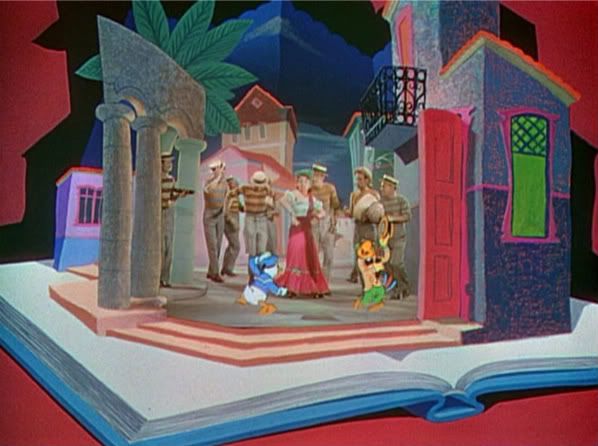
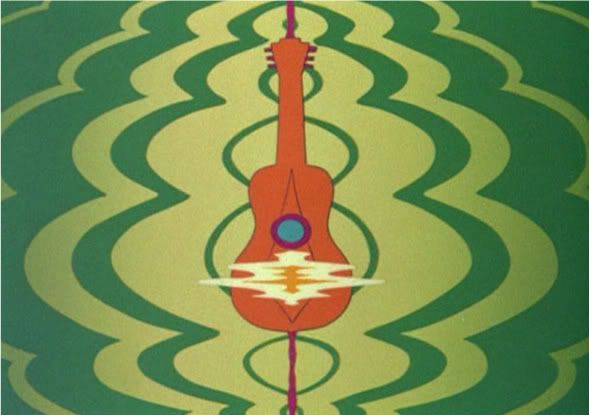
But Brian's post asks how we begin to understand the film as film. I'd suggest a few areas that fascinated me watching Three Caballeros. First, abstraction. Disney films of this period could often veer away from representation proper into a play with visual and aural elements. And its approach to representation in general showed a visual inventiveness. My favorite moments tended to be the most purely abstract ones:
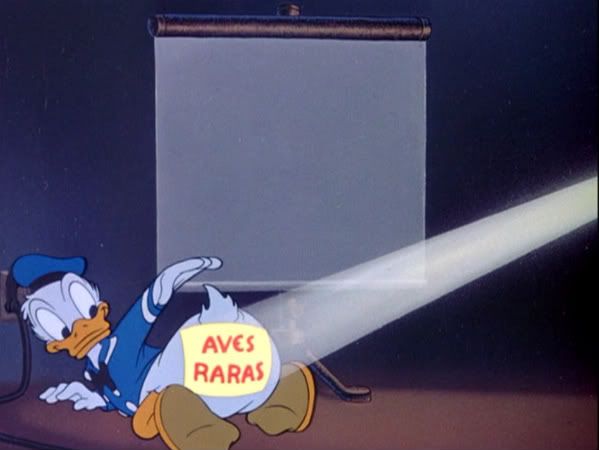

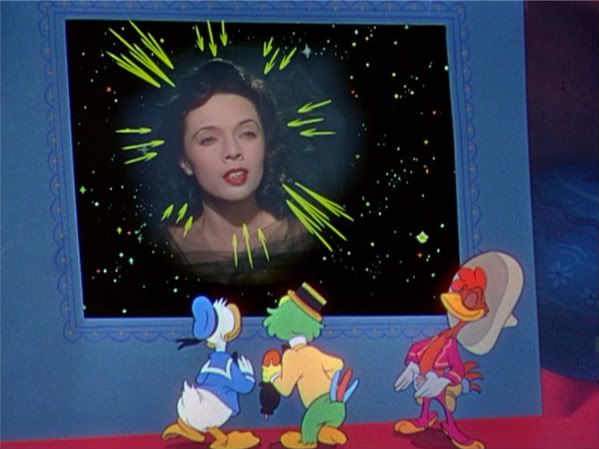
Second, the blend of live action and animation. Normally, I'm not a fan of the blend (maybe bad 70s examples soured me as a child), but I loved the interplay between the two spaces here. Shadows, for instance, could reflect from real objects onto drawn ones...


... and in the process make the three-dimensional live-action person look flat and unreal. Or, shadows could be cast from the animated characters onto a live action space...


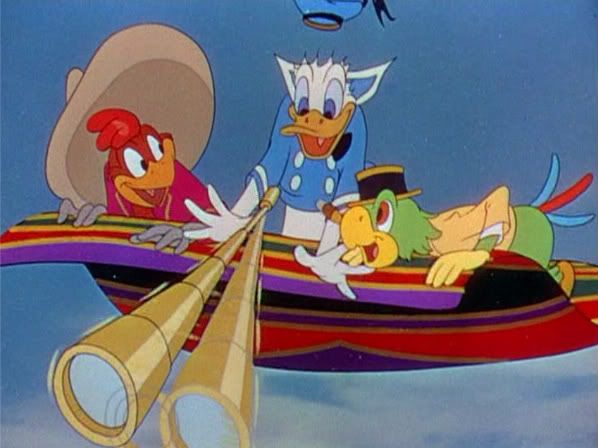
Finally, I was interested in the film's use of optical printing. For instance, there are several moments of freeze frame:


But particularly striking are the rain-wipes that create dazzling watercolor-y effects.


These effects interest me because they show a greater Hollywood lexicon of effects in the mid-40s, but also because they take effects with fairly conventionalized use in live-action films and give them a different function in the animated film, either more playful or more expressive.